In addition to the five daily prayers strictly commanded by Allah, Islam deeply encourages Muslims to voluntarily perform extra prayers throughout the day and night to elevate their spiritual state.
These additional prayers are commonly known within Islamic jurisprudence as Sunnah and Nafl prayers. While they are not strictly obligatory, they provide profoundly significant spiritual benefits and dramatically strengthen a believer's intimate connection with Allah.
Many dedicated Muslims choose to perform voluntary prayers immediately before or after the required five daily prayers to frame their obligatory worship with extra devotion.
Others seek out quiet, hidden moments, performing them at special times such as during the deep darkness of the night (Tahajjud) or the bright middle of the morning (Duha).
The core philosophy of voluntary worship in Islam rests on the profound concept of love. While obligatory acts (Fard) prove a servant's obedience and submission to their Creator, voluntary acts prove a servant's burning love and desire for proximity to the Divine.
Think of the obligatory prayers as the heavily fortified foundations and load-bearing walls of a house. They are absolutely non-negotiable for the structure to stand upright and survive the storms of life.
However, the voluntary prayers are the beautiful interior design, the elegant furnishings, the protective roof, and the illuminating windows that transform a bare, structural house into an incredibly beautiful, beloved home.
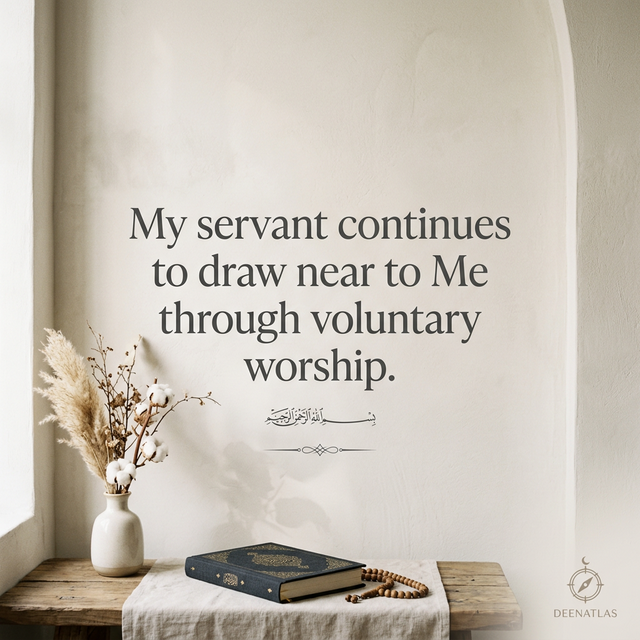
In an incredibly famous Hadith Qudsi (a direct saying of Allah reported by the Prophet ﷺ), Allah makes a staggering declaration regarding voluntary worship. He states that while obligatory duties are the most beloved way to approach Him, it is through the relentless pursuit of voluntary, optional acts that a servant finally earns His profound, intimate love.
Once that divine love is secured, Allah says He becomes the very hearing with which the servant hears, the sight with which they see, the hand with which they strike, and the foot with which they walk.
This incredible metaphorical description highlights how a life saturated in voluntary prayers completely transforms a person’s perception, actions, and reactions, bringing them entirely into alignment with divine guidance and protection.
Furthermore, the Prophet ﷺ informed us that on the Day of Judgment, the very first action a person will be terrifyingly held accountable for is their obligatory daily prayers.
If those obligatory prayers are found to be severely lacking, incomplete, rushed, or fatally flawed by a lack of concentration, Allah will mercifully command the angels to look into the servant's record of voluntary (Nafl) prayers.
If the servant has a strong reserve of voluntary prayers, those extra acts will dynamically act as a spiritual patch, automatically filling the gaping holes and repairing the deficiencies in their obligatory worship.
Therefore, voluntary prayers serve not only as a spiritual elevator in this world but as a desperately needed safety net in the next.
In this incredibly comprehensive guide, we will systematically explain exactly what voluntary prayers are, dissect the technical difference between Sunnah and Nafl prayers, list the most common voluntary prayers Muslims perform daily, and detail the incredible benefits of this additional, life-changing worship.
Note on Foundational Worship:
Voluntary prayers cannot replace obligatory prayers.
If you have years of missed obligatory prayers, scholars
generally advise replacing your Sunnah prayers with
makeup (Qada) prayers instead. Before mastering voluntary
prayers, ensure your obligatory foundation is completely
solid:
- How to Pray in Islam (Salah)
- Rakats in Each Salah
- Witr Prayer Explained
- Tahajjud Prayer Guide
Discover Voluntary Prayers
The sheer volume of different voluntary prayers available in the Islamic tradition can sometimes feel overwhelming for beginners and even experienced worshipers trying to build a routine.
Because the Islamic day mathematically revolves around the movement of the sun, voluntary prayers are highly contextual. They depend entirely on the time of day, whether they are attached to an obligatory prayer, or whether they require waking up from sleep.
To make this incredible tradition deeply accessible, we have built the interactive tool below. Use the tool below to comfortably explore the various optional prayers you can effortlessly add to your daily spiritual routine.
Simply select a specific time of day, toggle whether it is before or after a prayer, or investigate night prayers. The tool instantly suggests the most authentic voluntary prayers, detailing when they are performed, the exact number of Rakats, and their immense spiritual benefits according to Prophetic tradition.
By utilizing this tool, you can strategically architect a customized daily worship plan that comfortably fits your busy modern lifestyle while deliberately maximizing your spiritual growth.
Sunnah Rawatib (Before & After Obligatory)
Timing: These are performed directly before or after the five daily obligatory (Fard) prayers.
- Fajr: 2 Rakats before Fard.
- Dhuhr: 4 Rakats before Fard, 2 Rakats after Fard.
- Maghrib: 2 Rakats after Fard.
- Isha: 2 Rakats after Fard.
Spiritual Benefit: They plug the deficiencies in our obligatory prayers and serve as a protective spiritual buffer.
Night Prayers (Tahajjud & Witr)
Timing: Performed after Isha prayer and ideally after waking up from sleep, ending before true dawn (Fajr time).
Tahajjud (Qiyam al-Layl): The most highly recommended of all voluntary prayers. Prayed in units of two Rakats. It is a time when Allah descends to the lowest heaven to answer prayers.
Witr: The final prayer of the night, prayed with an odd number of Rakats (1, 3, 5, etc.). The Prophet ﷺ never missed this, even while traveling.
Morning & Day Prayers (Duha)
Timing: Begins approximately 15-20 minutes after sunrise and ends about 10 minutes before Dhuhr prayer (when the sun reaches its zenith).
- Rakats: Minimum of 2 Rakats, up to 8 Rakats (some scholars say unlimited).
- Also Known As: Salat al-Awwabin (The Prayer of the Oft-Returning), or Ishraq if prayed immediately after sunrise.
Spiritual Benefit: It serves as charity (Sadaqah) for every single joint in the human body and brings blessing and provision to one's daily affairs.
General Voluntary Prayers (Nafl Mutlaq)
Timing: Can be performed at any time of day or night, except during the prohibited times (exactly at sunrise, high noon, and exactly at sunset).
What is it? Simply deciding to pray 2 Rakats out of love for Allah without associating it with a specific recommended time.
Spiritual Benefit: As stated in the Hadith Qudsi, continued voluntary worship makes you beloved to Allah until He becomes "the hearing with which you hear and the sight with which you see."
3. What Are Voluntary Prayers?
To deeply understand voluntary prayers, we must first look at the linguistic meaning of the terms involved. In Arabic Islamic terminology, the word Fard stands for that which is strictly obligatory and mandatorily commanded by Allah.
Anything that falls outside of that strict Fard category is broadly considered voluntary. These are actions that a believer chooses to undertake out of their own free will to essentially "go the extra mile" in their desperately needed spiritual journey.
In the realm of formal prayer (Salah), this means actively choosing to stand, bow, and prostrate before Allah at times when you are not technically required to do so.
It is literally the act of sacrificing your extremely valuable free time, your physical energy, and occasionally your desperately needed sleep, solely for the sake of the Divine.
The Theological Foundation: Voluntary prayers are the ultimate proof of a servant's sincerity. If a person only ever does what they are forced to do under threat of punishment, their relationship is primarily based on fear.
The Shift to Love: When a person actively seeks out extra ways to worship, even when they know there is absolutely no punishment for leaving it, their relationship shifts radically from mere fearful obedience to pure, undeniable love.
Historically, throughout the incredibly rich, 1400-year history of Islam, the greatest scholars, ascetics, and spiritual masters were always known not just for upholding their obligatory prayers, but for their incredibly immense dedication to voluntary prayers.
Some of the famous companions of the Prophet ﷺ would spend the entire night in voluntary prayer, finding more comfort, peace, and psychological rest in their prostration than they ever found in their soft beds.
This is primarily because voluntary prayers fundamentally change the dynamics of how a human being interacts with this temporary world (Dunya). When you are constantly breaking away from work, entertainment, or socializing to voluntarily remember Allah, material stress dramatically loses its overpowering grip on your heart.
Furthermore, the Quran explicitly praises those who deeply engage in voluntary night worship. In Surah As-Sajdah, Allah beautifully describes the true believers by stating:
"Their sides shun their beds, as they desperately call upon their Lord in intense fear and hopeful expectation..." (Quran 32:16)
It is critically vital to note that voluntary prayers utilize the exact same physical and verbal mechanics as the obligatory prayers. You still face the Qiblah, you still require a state of ritual purity (Wudu), you still bow, and you still prostrate.
You do not invent new movements or new styles of worship. The only fundamental difference lies within the internal intention (Niyyah)—you are actively intending to pray a Sunnah or Nafl prayer rather than a Fard one.
In fact, it is through the precise repetition of these exact same sacred movements during the quiet, pressurized moments of voluntary prayer that a Muslim truly perfects their physical technique and immensely improves their internal concentration (Khushu).
4. The Difference Between Sunnah and Nafl
As a beginner learning about Islamic worship, or even as a lifelong Muslim looking to deepen your understanding, you will constantly hear the wildly interchangeable terms "Sunnah" and "Nafl".
While both broadly fall directly under the massive umbrella category of "voluntary" (meaning you will not be punished for skipping them), Islamic jurisprudence (Fiqh) draws a very important, highly specific technical distinction between the two.
Understanding this subtle distinction is critical because it helps you mentally prioritize which optional prayers you should actively focus on building into your overwhelming daily routine first.
Understanding "Sunnah" Prayers
The term Sunnah linguistically means "the path" or "the established way". In the strict context of prayer, Sunnah refers to the specific, structured voluntary prayers that the Prophet Muhammad ﷺ consistently and routinely performed.
These are prayers that he highly emphasized through his own relentless personal practice and heavily encouraged his beloved companions to adopt. Because they are directly attached to the Prophet's specific daily routine, they hold a significantly higher spiritual weight than general voluntary prayers.
Sunnah Mu'akkadah (Emphasized): These are the voluntary prayers the Prophet ﷺ almost never missed, not even when he was facing severe illness or intense hardship (e.g., the 2 Rakats before Fajr).
Sunnah Ghayr Mu'akkadah (Non-Emphasized): These are prayers the Prophet ﷺ performed frequently but would occasionally leave to explicitly demonstrate to the Ummah that they were not strictly obligatory (e.g., 4 Rakats before Asr).
When Islamic scholars strongly advise a person to "start performing voluntary prayers," they are almost exclusively referring to beginning with the intensely emphasized Sunnah prayers that surround the obligatory daily prayers.
Understanding "Nafl" Prayers
The term Nafl (plural: Nawafil) linguistically means "extra" or "supererogatory". In Fiqh, Nafl refers to any general, open-ended voluntary prayer that a person decides to perform purely out of their own completely free will.
Unlike Sunnah prayers, Nafl prayers are completely unrestricted in number. If you suddenly feel an overwhelming surge of gratitude on a random Tuesday afternoon, you can simply do Wudu and pray two Rakats of Nafl.
If you are gripped by intense anxiety regarding a rapidly approaching deadline or financial crisis, you can stand up in the middle of the night and perform six Rakats of Nafl just to pour your heart out in prostration.
- No Set Limits: While Sunnah prayers have specific set numbers (e.g., exactly two before Fajr), Nafl prayers can theoretically be prayed endlessly (in units of two), so long as it is not during a strictly forbidden time.
- Absolute Freedom: Nafl is the ultimate vehicle for highly personal, intimate, unstructured devotion whenever the heart requires an immediate, uninterrupted connection with God.
To summarize the difference simply: Every single Sunnah prayer is technically a Nafl (extra) prayer, but not every Nafl prayer is a Sunnah prayer.
Sunnah is the highly structured "extra" established directly by the Prophet ﷺ, while Nafl is the totally unrestricted "extra" initiated entirely by the individual worshiper.
5. Common Voluntary Prayers
Beyond the daily Sunnah Rawatib (which we will cover in detail in section 7), Islamic tradition is rich with specific, named voluntary prayers that serve distinct spiritual and psychological purposes.
These prayers are incredible tools given to the believer to navigate the emotional, financial, and spiritual challenges of human existence. They provide a direct, formal mechanism to seek divine intervention outside of the five daily Fard prayers.
Tahajjud (The Night Prayer)
Tahajjud is universally regarded by scholars of all Madhabs as the absolute pinnacle of voluntary worship. It is the prayer of the spiritually elite, yet accessible to any believer willing to sacrifice a portion of their sleep.
It is performed in the final third of the night, after a person has slept and woken up, before the arrival of the Fajr dawn. The Prophet ﷺ said regarding this specific time:
"Our Lord descends to the lowest heaven when the last third of the night remains, saying: 'Who is calling upon Me that I may answer him? Who is asking from Me that I may give him? Who is seeking My forgiveness that I may forgive him?'" (Bukhari)
The deep silence of the night eliminates all worldly distractions and the very real danger of showing off (Riya). It is an intensely private meeting between the Creator and the created.
Salat al-Witr (The Odd-Numbered Prayer)
Witr literally translates to "odd". It is the final prayer of the night, designed to cap off all evening worship with an odd number of Rakats (usually 1 or 3).
The Prophet ﷺ emphasized it so heavily that the Hanafi school of thought classifies it as Wajib (necessary), a completely unique category just slightly below definitively obligatory (Fard).
Even while traveling, when the Prophet ﷺ would systematically shorten and combine his obligatory prayers, he absolutely never abandoned the Witr prayer, signifying its immense spiritual importance.
Salat al-Duha (The Morning Prayer)
Also beautifully known as the "Prayer of the Oft-Returning" (Salat al-Awwabin), this prayer is performed between sunrise and midday. It is a massive source of daily spiritual provision and physical blessing.
The Prophet ﷺ famously taught that every single morning, charity is due upon every single one of the 360 joints in the human body out of pure gratitude.
He then stated that performing just two simple Rakats of Duha prayer sufficiently fulfills this massive daily charitable obligation. It is the ultimate "life hack" for establishing daily gratitude.
Salat al-Istikhara (The Guidance Prayer)
When a Muslim faces a major life decision—such as marriage, accepting a new job, moving to a new city, or making a major financial investment—they are highly encouraged to perform Istikhara.
This consists of two Rakats of Nafl prayer, followed specifically by a beautiful, comprehensive Prophetic supplication (Dua). In this Dua, the believer openly admits their complete lack of foresight and asks Allah to facilitate the matter if it is good for their religion and life, or to aggressively block it if it is harmful.
It is the ultimate surrender of control and a profound psychological relief for anyone suffering from crippling decision anxiety.
Tahiyat al-Masjid (Greeting the Mosque)
Whenever a Muslim enters a mosque, it is highly recommended to pray two Rakats before sitting down. This is an act of spiritual courtesy, officially greeting the House of Allah before comfortably settling into it.
6. The Immense Benefits of Voluntary Prayer
The Islamic tradition views voluntary action not just as "bonus points," but as the critical required fuel for actual spiritual transformation. If you only ever perform the bare minimum requirements, your faith will likely plateau and eventually become dangerously vulnerable to erosion.
Building a consistent habit of voluntary prayer provides massive, tangible benefits that impact both the spiritual heart and the practical realities of the Day of Judgment.
1. The Spiritual Patch: As previously mentioned, the Prophet ﷺ explicitly guaranteed that Nafl prayers will automatically compensate for the terrifying deficiencies, lack of focus, and missing elements in our obligatory prayers on the Day of Judgment. No one's Fard prayers are perfect; voluntary prayers are our mandatory insurance policy.
2. Attaining Divine Love: The Hadith Qudsi confirms that while obligatory duties are the required foundation, it is the relentless pursuit of voluntary deeds that directly attracts the intense, protective love of Allah. Once this love is attained, a person's life is flooded with divine facilitation (Tawfiq).
Furthermore, consistently performing voluntary prayers provides profound psychological benefits. It aggressively trains the ego (Nafs) to submit. Waking up for Tahajjud when your body desperately craves sleep is the ultimate victory of the spiritual soul over the physical body.
It also drastically normalizes the act of communicating with God. When you only pray five times a day, prayer can occasionally feel like a rigid chore. When you pray voluntarily throughout the day, prayer becomes a fluid, continuous, extremely comforting conversation.
You begin to automatically turn to Salah whenever you are stressed, sad, or overwhelmed, exactly as the Prophet ﷺ used to do when he would say to Bilal, "Give us comfort by it (the prayer)."
Lastly, voluntary prayers in the home specifically bring immense barakah (blessing) to the household. The Prophet ﷺ advised believers not to turn their homes into graveyards.
While the Fard prayers are best performed in the mosque for men, the Sunnah and Nafl prayers are highly encouraged to be performed at home. This illuminates the living space with worship and provides an incredible, practical visual example for children growing up in the house.
7. Daily Sunnah Prayers Explained (Sunnah Rawatib)
The most important voluntary prayers a Muslim should focus on are the Sunnah Rawatib. These are the specific, emphasized prayers exactly attached to the front and back of the five daily obligatory prayers.
They act as a spiritual buffer. Praying Sunnah before the Fard helps you mentally transition from the chaos of the world into a state of deep reflection (Khushu). Praying Sunnah after the Fard helps ease you back into worldly affairs without abruptly cutting your connection with Allah.
The immense reward for maintaining these specific 12 Rakats daily is unparalleled. The Prophet ﷺ promised:
"Whoever prays twelve Rakats in a day and night, a house will be built for him in Paradise." (Muslim)
According to the majority of scholars (and specifically the Shafi'i and Hanbali schools), these highly emphasized 12 Rakats are broken down in the following exact structure:
- Fajr: 2 Rakats before the obligatory Fajr prayer. The Prophet ﷺ famously said these two Rakats are "better than the world and everything in it."
- Dhuhr: 4 Rakats before the obligatory Dhuhr prayer (prayed in sets of two) and 2 Rakats after the obligatory prayer.
- Asr: No emphasized (Mu'akkadah) Sunnah prayers are attached to Asr. (However, 4 general Rakats before Asr are highly praised, though not officially part of these 12).
- Maghrib: 2 Rakats after the obligatory Maghrib prayer.
- Isha: 2 Rakats after the obligatory Isha prayer.
For a beginner, the absolute most important of these to establish first are the 2 Rakats before Fajr. The Prophet ﷺ never abandoned them, regardless of whether he was comfortably residing in Medina or undertaking exhausting travels across the desert.
Once the Fajr Sunnah is established, slowly add the post-Maghrib and post-Isha Sunnahs, as they are relatively short and easy to perform before returning to your evening routine. Let the 12 Rakats be a long-term goal to build your spiritual disciplines.
8. Differences Between Madhabs (Schools of Thought)
While every major Islamic school of thought (Hanafi, Maliki, Shafi'i, and Hanbali) enthusiastically agree on the immense virtue and importance of voluntary prayers, there are subtle technical differences in how they categorize and perform them.
Understanding these differences helps cultivate deep tolerance and provides a much broader understanding of the incredibly intellectual Islamic tradition.
The Hanafi Approach: The Hanafi madhab heavily emphasizes the Witr prayer, elevating it to the status of Wajib (necessary). If a Hanafi misses Witr, they are strictly required to make it up (Qada). Additionally, they pray Witr as three continuous Rakats, similar to Maghrib, but with a recitation in the third Rakat.
The Shafi'i & Hanbali Approach: These schools primarily view Witr as a highly recommended Sunnah, not Wajib. They typically pray it by performing two Rakats, saying the Tasleem to exit the prayer, and then standing up to pray one single final Rakat.
Another key difference involves exactly when specific Sunnah prayers should be performed during the Friday Jumu'ah prayer. The Hanafi school recommends four Rakats before and four Rakats after the Jumu'ah prayer.
Conversely, the Shafi'i and Hanbali schools generally recommend two Rakats before and two (or four) after. Regardless of the school, the underlying principle remains identical: surround the obligatory worship with layers of voluntary protection.
A Note on Traveling (Qasr): When
a Muslim is traveling, the Prophet ﷺ would shorten
the 4-rakat obligatory prayers to 2. During this time,
he would also drop the associated Sunnah Rawatib entirely,
except for the two Rakats before Fajr and
the Witr prayer at night.
To learn more about exactly how to pray while traveling,
read our complete guide on the
Traveller's Prayer (Qasr).
9. Frequently Asked Questions (FAQ)
Voluntary prayers generate many incredibly common questions, especially for beginners attempting to balance their strict religious obligations with demanding modern lifestyles.
What is the difference between Sunnah and Nafl prayers?
Sunnah prayers are those specifically established and consistently performed by the Prophet Muhammad ﷺ (like the two Rakats before Fajr). Nafl refers to any general voluntary prayer a person chooses to perform beyond the established Sunnahs. Every Sunnah is a Nafl, but not every Nafl is a Sunnah.
Is it a sin to miss voluntary prayers?
No. It is never a sin to miss purely voluntary (Sunnah or Nafl) prayers. However, intentionally and chronically abandoning the highly emphasized Sunnah prayers (Mu'akkadah) is considered blameworthy by scholars, as it signifies a dangerous distancing from the Prophetic practice.
Can I pray voluntary prayers at any time?
No. There are three specific times when voluntary prayer is strictly forbidden: exactly as the sun is rising, when the sun is exactly at its highest point at noon, and exactly as the sun is setting. You must also avoid Nafl prayers after praying the Asr prayer until Maghrib begins.
If I have years of missed Fard prayers, should I still pray Sunnah?
This is a major point of scholarly debate. The majority view (especially in the Maliki, Shafi'i, and Hanbali schools) is that if you owe obligatory (Fard) prayers from your past, you must prioritize making them up (Qada) over performing optional Sunnahs. The logic is that paying off a debt is legally more important than giving optional charity.
Do I read out loud or silently in voluntary prayers?
For daytime voluntary prayers (like Duha or the Sunnahs of Dhuhr and Asr), the recitation must be done silently, just moving your lips. For nighttime voluntary prayers (like Tahajjud or the Sunnahs of Maghrib and Isha), you have the beautiful option to recite aloud, provided you do not disturb others who are sleeping.
Can I pray Nafl while sitting down?
Yes. Unlike obligatory prayers where standing is a strict pillar (Rukn) if you are physically able, voluntary prayers can legally be performed sitting down even if you are perfectly healthy. However, the Prophet ﷺ stated that the reward of praying sitting down (when capable of standing) is exactly half the reward of praying while standing.
10. Conclusion
Voluntary prayers represent the beautiful, expansive space in Islam where duty effortlessly transforms into pure love. They are the undeniable hallmark of a believer who genuinely deeply enjoys their private conversation with the Creator.
By slowly, deliberately integrating Sunnah Rawatib into your rigid daily schedule, occasionally waking up into the silent darkness for Tahajjud, and utilizing specific prayers like Istikhara for massive life decisions, you dynamically construct a totally impenetrable spiritual fortress around your heart.
Do not overwhelm yourself by attempting to adopt every single voluntary prayer immediately overnight. Start incredibly small. Master the two Rakats before Fajr, and let the spiritual momentum naturally carry you forward toward greater closeness with Allah.