Witr Prayer Explained: How Muslims Perform the Night Prayer
Discover the profound spiritual significance and practical steps of the Witr prayer, the essential nightly connection that seals a Muslim's day of worship.
1. Introduction: The Seal of the Night
In the spiritual rhythm of a Muslim's life, the day is anchored by the five obligatory prayers.
Yet, as the sun sets and the world settles into stillness, there remains one final, profound act of devotion that serves as the seal of the day's worship: the Witr prayer.
Witr, which literally translates to "odd number," is unique in its structure, its timing, and its spiritual intimacy.
It is not merely an additional prayer; it is a declaration of the Oneness of Allah and a final opportunity to seek forgiveness before sleep takes hold of the soul.
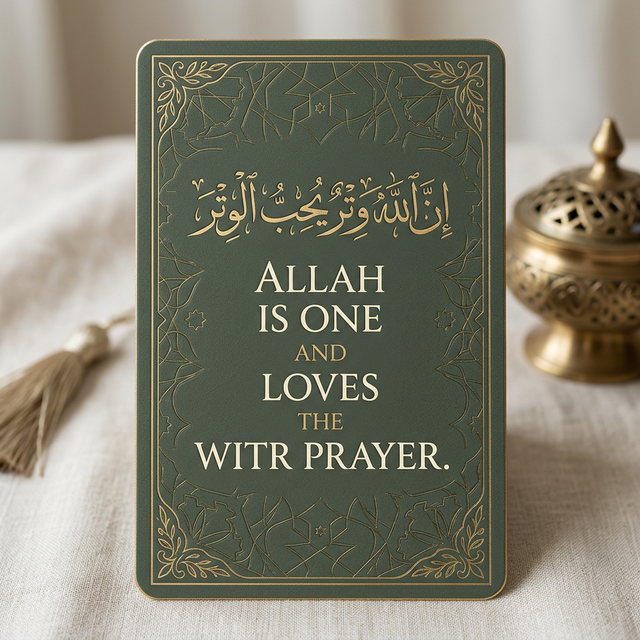
The Prophet Muhammad ﷺ emphasized the importance of Witr with great vigor, stating: "Allah is One (Witr) and He loves Witr, so perform the Witr prayer, O people of the Quran." (Sunan Abi Dawud)
For many, Witr is the highlight of the night, especially when performed in the quiet hours of Tahajjud.
However, its flexibility allows it to be accessible to everyone—from the busy professional praying immediately after Isha to the dedicated worshipper waking in the depths of the night.
In this guide, we will explore the nuances of Witr, its legal status across different schools of thought, and how you can integrate this beautiful practice into your nightly routine. Take a look at our how to pray guide if you need a refresher on the basics.
2. Plan Your Witr Prayer
Before we dive into the details, use our interactive planner to find the best Witr schedule for your lifestyle.
Plan Your Witr Prayer
Customize your nightly Witr prayer based on your schedule and preference.
1. When will you pray?
2. How many Rakats?
Your Custom Witr Plan
Selecting the right timing for Witr is crucial for consistency. While the last third of the night is superior, the Prophet ﷺ advised those who fear they will not wake up to pray Witr before they sleep.
Consistency (Istiqamah) is more beloved to Allah than a single night of intense effort followed by weeks of neglect.
Whether you choose one rakat or eleven, the key is to make it a permanent fixture in your life.
3. What is Witr? Understanding its Essence
The word "Witr" in Arabic refers to an odd number. In the context of Islamic jurisprudence, it is a specific prayer offered after the Isha (night) prayer, ending in an odd number of rakats.
It serves as the final prayer of the night, distinguishing the night's voluntary prayers from the day's obligatory ones.
Scholars have long debated the exact legal status of Witr. In the Hanafi school, it is considered Wajib (obligatory/necessary)—meaning it is a sin to deliberately skip it.
In the Shafi'i, Maliki, and Hanbali schools, it is classified as Sunnah Mu'akkadah (a highly emphasized Sunnah), an act of worship the Prophet ﷺ never left, even while traveling.
Regardless of the technical classification, there is unanimous agreement that Witr is one of the most virtuous extra prayers a Muslim can perform.
It is the prayer that "closes the record" of your daily deeds, leaving your final statement to be one of prostration and praise.
4. Timing and Virtue: When is Witr Performed?
The window for Witr is generous, designed to accommodate the varied lives of believers.
It begins immediately after the performance of the Isha prayer and extends until the first light of dawn (Fajr) appears on the horizon.
However, within this broad window, there are various levels of excellence.
Understanding these levels allows you to choose a time that challenges you spiritually without causing you to miss the prayer entirely.
The Three Windows of Witr
- The Early Window: Praying immediately after Isha. This is recommended for those who are tired, have busy early mornings, or fear they will not wake up before Fajr. It is better to pray Witr early and safely than to intend to pray late and sleep through it.
- The Middle Window: Praying just before sleep. This was the specific advice given by the Prophet ﷺ to Abu Hurayrah (RA), who was a dedicated student of knowledge and often stayed up late studying.
- The Optimal Window: Praying in the last third of the night. This is the time of divine descent, when Allah (SWT) responds to those who call upon Him. If you regularly wake up for Tahajjud, your Witr should be your final act of worship for the night.
A Vital Rule: No Two Witrs in One Night
The Prophet ﷺ said: "There are no two Witrs in one night." (Tirmidhi). If you pray Witr early after Isha and then happen to wake up for Tahajjud, you can pray as many extra units as you like, but you do not repeat the Witr. Your earlier prayer holds firm.
The Virtues of the Night Prayer
Why did the Prophet ﷺ never leave Witr, even while traveling on a camel? Because Witr is the culmination of the Qiyam al-Layl (night vigil).
The night prayer is described in the Quran as being "more effective for coordination [of soul and body] and more established in speech" (73:6).
When you stand for Witr, the world is quiet, your distractions are minimized, and your heart is at its most raw and honest state.
5. How to Pray Witr: Step-by-Step Method
While the standard movements of Witr are identical to other prayers, its specific grouping of rakats and the inclusion of the Dua Qunoot make it distinct.
The most common way to perform Witr is in three rakats, but it can be done in different ways depending on your level of dedication or the school of thought you follow.
Option 1: The Three-Rakat Witr (Hanafi Method)
In the Hanafi school, the three rakats of Witr are performed continuously, similar to the Maghrib prayer, but with two key differences:
- You recite an additional Surah after Al-Fatiha in all three rakats.
- In the third rakat, before bowing (Ruku), you raise your hands to your ears, say "Allahu Akbar," refold your hands, and recite the Dua Qunoot.
Option 2: The Two + One Method (Shafi'i/Hanbali/Maliki)
This is the method favored by the majority of scholars. You perform two rakats as a normal voluntary prayer (Shaf') and end it with the Tasleem (Salam).
Then, you stand up and perform a single separate rakat (Witr) to complete the set.
In this method, the Dua Qunoot is usually recited after rising from the Ruku in the final rakat.
What to Recite in Witr?
It is highly recommended (Sunnah) to recite specific chapters if you are praying the 3-Rakat Witr. Check out our what to recite guide for more details on general prayer surahs.
Specifically, for the 3-Rakat Witr, the Sunnah is:
- 1st Rakat: Surah Al-A'la (The Most High)
- 2nd Rakat: Surah Al-Kafirun (The Disbelievers)
- 3rd Rakat: Surah Al-Ikhlas (Sincerity)
This sequence creates a beautiful thematic progression, beginning with the praise of Allah's transcendence and ending with the definitive declaration of His absolute Oneness.
6. Number of Rakats: Flexibility and Choice
One of the most beautiful aspects of the Witr prayer is its inherent flexibility.
Unlike the five daily obligatory prayers, which have a fixed number of units, Witr can be performed in several ways.
The fundamental rule is that it must be an odd number. This is because "Witr" literally means "odd" or "one," representing the absolute Oneness of the Creator.
The Prophet ﷺ taught that Witr can be performed as one, three, five, seven, nine, or eleven rakats.
Each of these variations is documented in the authentic Sunnah, giving you the freedom to choose.
The One Rakat Witr
The absolute minimum for Witr is a single rakat. This is the practice often associated with the Shafi'i and Hanbali schools of thought.
It is a powerful, singular unit of worship that summarizes the day's devotion in one final stand before Allah.
If you are extremely exhausted, this is your spiritual lifeline.
Even in this single rakat, the full sequence of standing, recitation (Fatiha and a Surah), Ruku, and Sujood is completed, followed by the final sitting and Tasleem.
The Three Rakat Witr: Two Methods
As discussed in the previous section, the three-rakat Witr is the global standard. Whether you pray it as a continuous block or as a 2+1 unit, it fulfills the Sunnah.
The Prophet ﷺ occasionally changed his method to teach different valid structures to his companions. This variety is a mercy for the believers, allowing different cultural traditions to thrive.
Extended Witr (5, 7, 9, 11)
When the Prophet ﷺ prayed five or seven rakats, he would sometimes not sit for Tashahhud until the very final rakat. This creates a state of deep meditative flow.
For nine rakats, he would sit at the eighth unit to perform Tashahhud and Dhikr, and then stand again for the ninth before finishing. This is for those who find strength in prolonged standing.
These extended versions are typically performed during the last third of the night, combining the virtues of Tahajjud (night prayer) and Witr (the seal).
7. The Dua Qunoot: The Soul of Witr
Perhaps the most distinctive feature of the Witr prayer is the Dua Qunoot (The Supplication of Standing).
The word "Qunoot" implies humility, devotion, and prolonged standing in worship. It is a moment where the formal structure of the prayer yields to a deeply personal and communal supplication.
When is it Recited?
As discussed earlier, the timing of the Qunoot varies by school of thought:
- Hanafi: Recited in the third rakat before going into Ruku. After the additional Surah, the hands are raised to the ears (Takbir) and then refolded for the Dua.
- Shafi'i/Hanbali: Recited in the final rakat after rising from the Ruku. The hands are raised in front of the chest in a gesture of supplication.
The Prophet's ﷺ Teaching: A Word-by-Word Breakdown
The Prophet ﷺ taught Al-Hasan ibn Ali (RA) a specific supplication that is considered the most foundational wording for Witr. Let us look at the profound meanings behind these specific phrases:
اللَّهُمَّ اهْدِنِي فِيمَنْ هَدَيْتَ
"Allahumma-hdini fiman hadayt"
"O Allah, guide me among those You have guided."
By asking for guidance "among those You have guided," we are asking not just for individual direction, but for the companionship of the righteous.
This includes the Prophets, the Truthful, the Martyrs, and the Pious. We acknowledge that guidance is a gift that can only be sustained by Divine Mercy.
وَعَافِنِي فِيمَنْ عَافَيْتَ
"Wa 'afini fiman 'afayt"
"And grant me health/well-being among those You have granted health."
The word 'Afiyah (well-being) is one of the most comprehensive terms in the Arabic language.
It includes physical health, mental clarity, and spiritual integrity. It is protection from calamity in this world and the next.
وَتَوَلَّنِي فِيمَنْ تَوَلَّيتَ
"Wa tawallani fiman tawallayt"
"And take me into Your charge among those You have taken into Your charge."
This is a request for "Wilayah"—Divine Guardianship.
When Allah becomes your Wali (Guardian), He manages your affairs, protects you from your enemies, and guides your choices.
You are effectively saying, "O Allah, I cannot manage my life alone; I hand it over to You."
وَبَارِكْ لِي فِيمَا أَعْطَيْتَ
"Wa barik li fima a'tayt"
"And bless me in what You have given me."
Quantity is often meaningless without Barakah (Blessing).
We ask Allah to put Barakah in our time, our wealth, our families, and our knowledge.
Barakah is what makes a single hour productive, a small meal satisfying, and a simple act of worship transformative.
Without this divine increase, we find ourselves running faster but achieving less, always wanting and never feeling full.
وَقِنِي شَرَّ مَا قَضَيْتَ
"Wa qini sharra ma qadayt"
"And protect me from the evil of what You have decreed."
We acknowledge that while everything comes from Allah, our limited human perspective might perceive certain decrees as "evil" or painful.
We ask for the strength to endure trials and the wisdom to see the hidden mercy in the moments that challenge our resolve.
The Emotional Power of Qunoot
In many mosques, especially during the month of Ramadan, the Dua Qunoot becomes a source of collective healing.
The Imam may cry, and the congregation responds with "Ameen."
However, the Qunoot you pray alone in your room is where the real work happens.
It is where you can be completely honest about your fears, your mistakes, and your hopes.
Do not rush this part of the prayer. The standing is prolonged specifically so that you have time to pour your heart out to your Lord.
It is a time for total vulnerability.
8. Madhab Differences: Unity in Diversity
Islamic jurisprudence is a vast ocean.
The differences in how Witr is performed are a testament to the richness of our tradition.
Rather than being a source of confusion, these variations allow for flexibility.
They ensure that the Sunnah is preserved from multiple valid perspectives.
Hanafi School
- Witr is Wajib (Necessary).
- Always 3 Rakats performed together.
- One Tasleem at the very end.
- Qunoot is before Ruku.
Majority Schools
- Witr is Sunnah Mu'akkadah.
- Can be 1, 3, 5, etc. Rakats.
- Often 2+1 separate units.
- Qunoot is usually after Ruku.
It is important to note that all of these methods are rooted in authentic narrations from the Prophet ﷺ.
If you are praying behind an Imam who follows a different school, you should follow their lead in the prayer.
This is a crucial point of etiquette.
Unity and following the Imam (Iktida) are of higher priority than insisting on your specific school's minute details.
This applies especially in a congregational prayer context.
9. Witr in Ramadan: The Night of Power
The month of Ramadan brings a unique flavor to the Witr prayer. During this blessed month, Witr is performed in congregation after the Tarawih prayers.
For many Muslims, this is the only time they perform Witr in a group. The energy of the mosque and the communal "Ameen" make it a powerful experience.
In some traditions, the Dua Qunoot in Ramadan is extended to include supplications for the entire Muslim Ummah, for those suffering, and for the forgiveness of the deceased.
It becomes a collective moment of spiritual yearning that often leaves the congregation in tears, especially on the odd nights of the last ten days.
10. Etiquettes of the Night Prayer
To truly benefit from Witr, one should observe the etiquettes and external manners that the Prophet ﷺ and the companions followed.
- Stillness (Tuma'ninah): Do not race through your Witr. Each movement should be performed with calmness and focus.
- Siwak: Using the Siwak before starting the night prayer is a highly recommended Sunnah.
- Dua after Tasleem: After finishing Witr, it is Sunnah to say "Subhanal-Malikil-Quddus" three times, raising your voice slightly on the third.
These small additions transform the prayer from a mere ritual into a powerful meditative experience.
The night prayer is your time to be away from the noise of the world and to reflect on your relationship with your Lord in total silence.
11. Common Mistakes to Avoid
In our journey to perfect our Witr, it is helpful to be aware of common pitfalls that can diminish the quality or validity of the prayer according to different schools.
One frequent mistake is praying Witr exactly like Maghrib. The Prophet ﷺ explicitly forbade this to ensure Witr remains distinct as a voluntary night prayer.
To avoid this, scholars recommend either praying the 2+1 method or, if praying 3 together (Hanafi), ensuring you recite a Surah in the third rakat and include the Dua Qunoot.
- Rushing the Qunoot: The Qunoot is a moment of conversation. Many people treat it as a hurdle to get over rather than a destination to enjoy.
- Skipping the Sitting: Unless you are praying a specific Sunnah variation that omits it, ensure you sit for the final Tashahhud to properly complete the legal requirements.
- Repeated Witrs: The Prophet ﷺ said: "There are no two Witrs in one night." (Tirmidhi).
- If you pray Witr early after Isha and then happen to wake up for Tahajjud, you can pray as many extra units as you like, but you do not repeat the Witr. Your earlier prayer holds firm.
Another common error is neglecting the stillness (Tuma'ninah) in the transitions. Because Witr is at the end of the day, fatigue can lead to "pecking like a bird."
Take your time. Each movement in Witr is a final gift you are giving to your soul before the day concludes. Treat it with the respect it deserves.
12. The Spiritual Fruits of Witr
Why does the Witr prayer hold such a high status in Islam? Beyond the legal requirements, it offers profound spiritual benefits for the practitioner.
Witr is the "Seal of the Day." It ensures that your last conscious act before sleep is a declaration of Allah's Oneness and a plea for His guidance.
By performing Witr, you are essentially "closing your account" for the day with a profit of devotion. It provides a sense of closure and readiness for the unknowns of tomorrow.
"The prayer is a light, and the Witr is an extra light for the one who seeks to brighten their heart in the darkness of the night."
Regularity in Witr builds an internal discipline that carries over into other areas of life. It teaches us that the most important conversations often happen when the world is looking away.
It is in this solitude that true sincerity (Ikhlas) is forged. There is no one to impress at 3 AM except the One who created you.
13. Building the Witr Habit: A DeenAtlas Plan
Consistency is the most beloved quality in any act of worship. For many, the challenge with Witr isn't how to pray it, but how to pray it every night.
We recommend a modular approach to building this habit, starting from where you are and gradually increasing your commitment as your spiritual stamina grows.
Phase 1: The 'No-Excuses' Witr (Days 1-10)
For the first ten days, your goal is simply to perform one rakat of Witr immediately after your Isha prayer.
Don't worry about wake-up times or long supplications. Just secure the single odd rakat before you leave the mosque or your prayer mat.
Phase 2: The Sunnah Standard (Days 11-20)
Once you are comfortable with one rakat, move to three. Begin to incorporate the Sunnah surahs (Al-A'la, Al-Kafirun, Al-Ikhlas).
At this stage, try to push your Witr back by thirty minutes each night, moving closer to your actual bedtime.
Phase 3: The Night Watchman (Days 21-30)
In the final phase, aim to pray Witr in the last third of the night at least twice a week.
This is when you add the full Dua Qunoot with sincerity and take your time in the physical movements of the prayer.
If you miss a night, do not despair. Simply make it up the following morning as a 'Duha' prayer (in an even number) and return to your routine that night.
The goal is not perfection, but persistence. Allah loves those who keep returning to Him, regardless of how many times they stumble along the way.
14. Frequently Asked Questions
Can I pray Witr while traveling?
Yes, absolutely. The Prophet ﷺ never left the Witr prayer or the two Sunnah rakats of Fajr, even when he was on a journey. In fact, he would often perform Witr while riding his camel. This shows its incredible status. Even when you are shortening (Qasr) your obligatory prayers, Witr remains a fundamental part of your night.
Is Witr obligatory (Fard)?
It is not one of the five Fard (obligatory) prayers. However, in the Hanafi school, its status is Wajib, which is technically just below Fard in terms of necessity. In other schools, it is a Sunnah Mu'akkadah. Historically, many scholars were so strict about Witr that they said a person who habitually leaves it is not fit to give testimony in an Islamic court.
What if I miss Witr? Can I make it up (Qada)?
Yes. If you accidentally sleep through Witr or forget to pray it, you can make it up the next morning. Most scholars suggest making it up between the Fajr and Dhuhr prayers. However, as a point of technicality, if you make it up in the morning, you should pray an even number of rakats (Shaf') rather than an odd number to distinguish it from the actual night Witr.
Can I pray Witr in a chair?
Since Witr is technically a voluntary (though highly emphasized) prayer, the rules for standing are more relaxed than in the Fard prayers. You are permitted to pray Witr sitting in a chair even if you are capable of standing, though your reward is halved. This flexibility is allowed specifically to encourage people to perform the night prayer even when they are feeling physically exhausted.
Do I have to say the Dua Qunoot every night?
This depends on your school. In the Hanafi school, it is necessary (Wajib). In the Shafi'i school, it is typically recited in the second half of Ramadan. In the Hanbali school, it is a Sunnah throughout the year. If you find it difficult, remember that even a short supplication or even a simple "Ya Allah forgive me" fulfills the basic requirement of Qunoot (devotion).
What is the difference between Witr and Tahajjud?
Tahajjud refers to any voluntary prayer performed during the night, specifically after waking up from sleep. Witr is the prayer that "seals" or completes the night worship.
Therefore, you can pray many rakats of Tahajjud (in sets of two), but you always finish with a single rakat (or a set of three) of Witr. Witr is the final destination of the night's journey.
Can I read the Dua Qunoot from a phone?
Yes, especially for beginners or those who are actively trying to memorize the specific Sunnah wording. You can hold your mobile phone or a small card in your hand and read the supplication during the standing portion of the Witr. Once you have it memorized, it is better to put the device away to ensure maximum focus and stillness.
What if I pray Witr and then decide to pray more?
This happens often when someone prays Witr after Isha thinking they will sleep, but then wakes up early in the night. You are allowed to perform as many voluntary (Nafl) units as you want. However, you do NOT repeat the Witr. The Prophet ﷺ said: "There are no two Witrs in one night." Your earlier Witr remains as the seal of your night, even if you performed it early.
15. Conclusion: Your Final Conversation
The Witr prayer is more than just a set of physical movements; it is your final conversation with your Creator before the day's record is closed and your spirit enters the state of sleep.
It is a moment to find peace in the Oneness of Allah and to seek His light for the darkness of the night and the uncertainties of tomorrow.
When you stand in the silence of the night, you are acknowledging that while the world may be asleep, the One who sustains the world is Ever-Watchful and Ever-Present.
This prayer is your spiritual insurance. It protects the heart from hardening and ensures that even if you never wake to see another dawn, your last act was one of submission.
Start where you are. If three rakats seem daunting, start with one. If the last third of the night is impossible, pray after Isha. Allah does not look at the length as much as He looks at the sincerity and the effort.
The beauty of Witr lies in its accessibility and its immense reward. It is a bridge between the noise of the day and the profound peace of the divine presence.
May Allah make us among those who never leave this sacred seal of the day, and may our Witr always be accepted as a sincere token of our love for the One.
Disclaimer: This guide provides an educational overview of Islamic prayer based on widely accepted scholarly sources. Minor differences exist between Islamic schools of thought (madhabs), and readers should follow the guidance of their local scholars or tradition where applicable.
Join the DeenAtlas WhatsApp Channel
Get weekly guides, prayer tips, and halal database updates directly to your phone.
Join Channel