I. Introduction to Wudu in Hadith
While the Quran establishes the obligation of purification before prayer, the details of Wudu are explained through the sayings and actions of the Prophet Muhammad ﷺ. These teachings are preserved in Hadith literature, providing us with the practical application of the Divine command.
Through these narrations, Muslims learn not only the physical mechanics of Wudu—such as the number of times to wash each limb—but also the deep spiritual dimension of the act. The Hadith literature transforms Wudu from a simple washing ritual into a profound process of spiritual renewal and cleansing of the soul.
The Hadith describe the exact actions of Wudu, the spiritual rewards associated with purification, and the deeper wisdom behind maintaining cleanliness before prayer. It is through the Prophet's ﷺ example that we understand why purification is described as "half of faith."
Key Themes in This Guide
- The most famous authentic Hadith regarding the virtues of Wudu.
- Step-by-step descriptions of the Prophet's ﷺ own Wudu sessions.
- The spiritual rewards and legal requirements as derived from the Sunnah.
- How major schools of thought (Madhabs) interpret these narrations.
If you are looking for the practical, step-by-step instructions on how to perform the ritual, please refer to our companion guide: How to Make Wudu (Step by Step). For the Quranic basis, see Wudu in the Quran.
Prophetic Wisdom: The Prophet ﷺ said, "Cleanliness is half of faith." This single statement elevates purity from a physical necessity to a fundamental pillar of a believer's spiritual existence.
II. Quick Answer: Why the Hadith is Essential
The details of Wudu are explained in numerous authentic Hadith of the Prophet Muhammad ﷺ. While the Quran mentions the four main pillars (washing the face, arms, wiping the head, and washing the feet), the Hadith adds the Sunnah elements like rinsing the mouth, cleaning the nose, and the repetitions.
These narrations describe how the Prophet ﷺ performed Wudu and explain the immense spiritual benefits, such as the washing away of sins with every drop of water. Without the Hadith, our understanding of purification would be incomplete and lack the nuances required for a perfected prayer.
| Source | Teaching & Role |
|---|---|
| Quran | Commands the obligation of purification before prayer. |
| Hadith | Explains the exact method and sequence of the Prophet ﷺ. |
| Scholars | Interpret the narrations to provide jurisprudential rules (Fiqh). |
Key Takeaway: The Quran provides the "what," but the Hadith provides the "how." To follow the Prophet ﷺ is to follow the path most beloved to Allah.
III. Explore Wudu in Hadith
Select a topic from the Hadith literature below to explore the prophetic teachings on purification. This tool highlights specific narrations and their scholarly interpretations.
Wudu Hadith Explorer
IV. Prophetic Teachings on the Virtues of Wudu
The Prophet Muhammad ﷺ did not treat Wudu as a chore or a mere legal requirement. Instead, he taught that it is a state of being that brings a believer closer to Allah. In many teachings, the Prophet ﷺ highlighted how Wudu acts as a protection (Hisn) for the believer. This protection is not just against external impurities, but acts as a spiritual guardian (Junnah) against the whispers of the self (Nafs) and the promptings of the Shaytan.
One of the most powerful teachings is the concept of Nur (Light). The Prophet ﷺ mentioned that the parts of the body washed during Wudu will shine with a divine light on the Day of Resurrection. This teaches us to wash carefully and thoroughly, as we are essentially "preparing our light" for the hereafter. This light is referred to as Ghurran Muhajjalin—the brilliance on the forehead and limbs that will make the believers stand out like white-marked horses in a dark herd.
Furthermore, the Prophet ﷺ taught that maintaining a state of Wudu throughout the day—even when not praying—is a sign of a strong believer. He said, "None maintains Wudu except a believer." This encourages mindfulness and a constant connection with the state of purity. It suggests that the state of Wudu is a spiritual uniform, a constant readiness to meet the Lord, and a way to transform everyday life into a series of sacred moments.
The Prophet ﷺ also emphasized the psychological impact of Wudu. He described it as a means to cool the flames of anger. "Anger is from the Devil, and the Devil was created from fire. Fire is only extinguished by water, so if one of you gets angry, let him perform Wudu." This demonstrates that the Prophetic teachings see a direct link between our physical state and our internal emotional and spiritual landscape.
Four Major Prophetic Virtues of Wudu
- Expiation of Sins: Minute sins are washed away limb by limb, leaving the soul as clean as the body.
- Elevating Ranks: Performing Wudu under difficult conditions (like cold weather) raises a person's status in the Sight of Allah.
- Guardian of the Heart: It keeps the soul alert, providing a buffer against negative energy and spiritual lethargy.
- Identity & Recognition: It is the primary way the Prophet ﷺ will recognize his followers among the billions on the Day of Judgment.
The "Cold Water" Hadith: The Prophet ﷺ asked, "Shall I not tell you something by which Allah erases sins and raises ranks?" They said, "Yes, O Messenger of Allah." He said, "Performing Wudu thoroughly in spite of difficult circumstances, walking many steps to the mosques, and waiting for the next prayer after the previous one; that is the Ribat (steadfastness)." (Muslim).
This teaching is particularly relevant for those living in colder climates or facing health challenges. The effort put into purification is directly proportional to the spiritual reward received. It demonstrates that Islam values the intention and the struggle behind every act of worship. It shift the focus from the 'ease' of the act to the 'devotion' expressed through the act, reminding us that the most beloved deeds to Allah are often those that require the most patience.
Moreover, the Prophet ﷺ encouraged the use of Miswak with every Wudu. This highlights the integral nature of holistic cleanliness. A believer's breath, body, and soul are all intended to be in a state of 'Tayyib' (wholesome purity). By following these small Sunnahs, we align our entire physiology with the Prophetic model of excellence.
V. Major Hadith About Wudu and Purification
The corpus of Hadith literature contains thousands of narrations regarding purification, but a few stand out as the "foundational" texts upon which Islamic practice is built. These narrations are primarily found in the "Two Sahihs" (Bukhari and Muslim) and the four "Sunan" collections. These collections are the primary filters through which scholars derive the practical Sunnah of the Prophet ﷺ.
One of the most frequently cited Hadiths is the narration of Abu Hurayrah (RA), who reported that the Prophet ﷺ said: "The prayer of a person who does not have Wudu is not accepted until he performs Wudu." (Bukhari & Muslim). This Hadith establishes Wudu not as an optional virtue, but as a mandatory legal requirement (Shart) for the validity of the most important pillar of Islam—the Salah.
Another pivotal narration concerns the 'washing away of sins.' The Prophet ﷺ explained that when water touches the eyes, the face, the hands, and the feet, the sins committed by those limbs literally fall away "with the last drop of water." This transformative imagery helps the believer visualize the spiritual cleansing happening alongside the physical one.
We also find Hadiths that warn against the 'sins of omission' in Wudu. The Prophet ﷺ once saw some people performing Wudu in a hurry, leaving their heels dry. He called out in a loud voice, "Woe to the heels from the fire!" This taught the companions that every part of the required limbs must be thoroughly reached by water for the purification to be valid.
Key Foundation Hadith
- The Key to Prayer: "The key to Paradise is prayer, and the key to prayer is purification." (Musnad Ahmad). This places Wudu at the very gate of eternal success.
- The Weight of Sins: "When a Muslim... washes his hands, every sin his hands have committed is washed away with the water..." (Muslim). This emphasizes the expiatory nature of the ritual.
- Completing Wudu: "Woe to the heels from the fire!" (Bukhari). This serves as a reminder for precision and mindfulness in our actions.
- Dua After Wudu: "Whoever performs Wudu and says... 'I bear witness that there is no god but Allah... the eight gates of Paradise are opened for him.'" (Muslim).
Scholarship has divided these Hadith into two categories: Hadith al-Ahkam (Hadith on rulings) and Hadith al-Fada'il (Hadith on virtues). The former provides the legal boundaries—what MUST be done for the Wudu to count. The latter provide the spiritual motivation—why we should want to do it well. A balanced Muslim practice requires an understanding of both, as the 'how' without the 'why' becomes dry ritualism, and the 'why' without the 'how' remains incomplete worship.
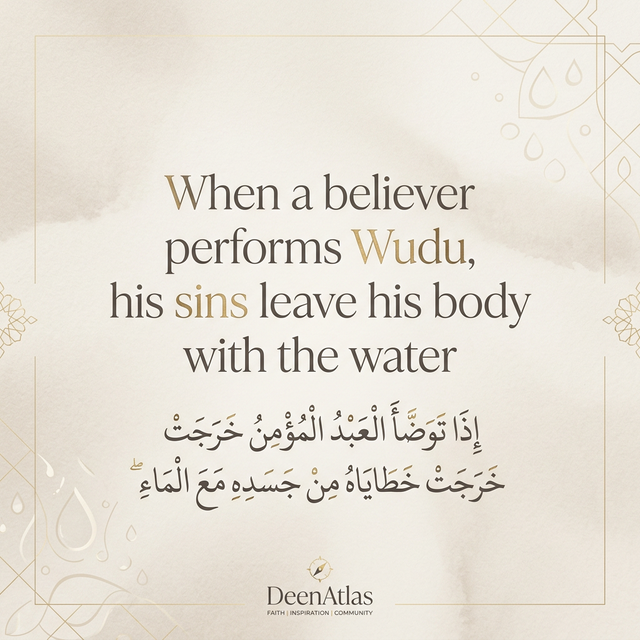
The "discovery" of the spiritual weight of Wudu often comes when examining the narration about the "bright limbs" on the Day of Judgment. The Prophet ﷺ said, "You will be the ones with bright streaks on your foreheads and bright marks on your hands and feet on the Day of Resurrection from the traces of Wudu." This creates a direct link between the mundane act of washing and our eternal identity in the afterlife.
Historical Insight: The early companions (Sahaba) were so meticulous about following these Hadith that they would observe the Prophet ﷺ for days just to capture a single nuance of his purification process.
VI. How the Prophet Muhammad ﷺ Performed Wudu
The "Perfect Wudu" (Al-Wudu al-Kamil) is described in great detail by the Prophet's ﷺ companions. The most comprehensive description comes from Uthman ibn Affan (RA), the third Caliph, who performed Wudu in public to teach the people exactly how the Prophet ﷺ did it.
According to the narration, the Prophet ﷺ would start by washing his hands three times, then rinse his mouth and nose together with one handful of water (or separate handfuls, depending on the report), then wash his face three times, his arms up to the elbows three times, wipe his head once (from front to back and back to front), and finally wash his feet up to the ankles three times.
| Step | Prophetic Action | Repetitions |
|---|---|---|
| Intent & Basmalah | Niyyah in the heart and saying Bismillah | Once |
| Washing Hands | Up to the wrists, cleaning between fingers | Three Times |
| Mouth & Nose | Rinsing (Madmadah) and snorting water (Istinshaq) | Three Times |
| Washing Face | From hairline to chin, and ear to ear | Three Times |
| Washing Arms | Right then left, including the elbows | Three Times |
| Wiping Head | Passing wet hands over the entire scalp | Once |
| Washing Feet | Right then left, ensuring heels are wet | Three Times |
One interesting nuance mentioned in the Hadith is the use of the "Siwak" (tooth-stick). The Prophet ﷺ said, "Were it not that I would burden my Ummah, I would have commanded them to use the Siwak with every Wudu." This shows that oral hygiene is an intrinsic part of the Prophetic vision of purification.
Try This: Next time you perform Wudu, try to visualize Uthman's (RA) narration and see if you can match the Prophet's ﷺ deliberate and careful pace.
The Hadith also warns against Israf (waste). The Prophet ﷺ would perform Wudu with a very small amount of water (approximately 600ml to 1 liter). This teaches us that the effectiveness of Wudu lies in the Barakah (blessing) of following the Sunnah, not in the volume of water used.
VII. Spiritual Lessons: Beyond the Physical
While the Fiqh (jurisprudence) focused on the physical validity of Wudu, the Hadith literature provides an ocean of spiritual wisdom that addresses the state of the heart. One of the most significant lessons is the concept of Taharah al-Batin (Inner Purity).
The Prophet ﷺ said, "The believer does not become najis (impure)." This profound statement teaches us that while our physical bodies may encounter ritual impurities (like urine or blood), our essential spiritual nature (the Fitrah) remains pure and beloved to Allah. Wudu is the process of bringing the physical state back into alignment with the pure spiritual state.
Four Spiritual Gems from Hadith
- Conscious Presence: Wudu acts as a "reset" for the mind, clearing the day's stress before meeting the Creator.
- Hope through Repentance: The washing away of sins encourages the believer to constantly turn back to Allah (Tawbah).
- Discipline of the Nafs: The habitual performance of Wudu trains the self in consistency and obedience.
- Universal Equality: The Prophet ﷺ performed Wudu just as his companions did, reminding us that we are all equal in our need for Divine mercy.
Another lesson is the concept of Shukr (Gratitude). The ability to use water to purify ourselves is a Mercy from Allah. The Prophet ﷺ reminded us to use water sparingly, acknowledging it as a precious resource. This links environmental stewardship directly to spiritual practice.
Spiritual Focus: When you wash your hands, think: "I am washing away the sins my hands have touched." When you wash your face, think: "I am seeking the Light of Allah."
| Action | Spiritual Symbolism |
|---|---|
| Washing the Face | Seeking the "Wajh" (Face) of Allah and Divine Favor. |
| Washing the Hands | Letting go of attachment to worldly gains and greed. |
| Wiping the Ears | Resolving to listen only to what is pleasing to Allah. |
| Washing the Feet | Asking for steadfastness on the Sirat (Bridge) in the Hereafter. |
VIII. Scholarly Commentary on Wudu Hadith
Great scholars of the past, such as Imam al-Nawawi, Imam ibn Hajar al-Asqalani, and Imam al-Ghazali, have spent years analyzing the Hadith of Wudu. Their commentaries explain the "secret" meanings that an average reader might miss.
Imam al-Ghazali, in his Ihya Ulum al-Din, notes that if a person only cleans their skin while neglecting their heart, they are like a person who invites a King to their home but only cleans the front porch while the inside is full of filth. Wudu, he argues, must be the start of an internal cleansing process.
Insights from the Masters
- Imam al-Nawawi: Emphasized the legal importance of the "Niyyah" (intention), stating that without it, the actions are mere washing, not worship.
- Ibn Hajar: Masterfully reconciled different narrations to show how the Prophet ﷺ varied his Wudu to show what is mandatory vs. recommended.
- Ibn al-Qayyim: Reflected on the "Nur" (Light) of Wudu as a literal spiritual energy that protects the believer from dark thoughts.
Scholarly Tip: Every drop of water carries away the "fog" that obscures the soul's vision. Treat Wudu as a form of "Meditation in Motion."
IX. Differences Between Madhabs on Wudu Hadith
While all four Sunni schools of thought (Hanafi, Maliki, Shafi'i, and Hanbali) rely on the same authentic Hadith, they sometimes differ in their legal conclusions. These differences arise from whether they view a certain action as Wajib (mandatory) or Sunnah (recommended).
For example, the Shafi'i school emphasizes the "Order" (Tartib) because they view the sequence in the hadith as a mandatory condition. The Hanafi school, relying on different narrations, believes the order is highly recommended but not a requirement for the validity of the Wudu itself.
| Madhab | Key Particularity | Basis from Hadith |
|---|---|---|
| Hanafi | Wiping 1/4 of the head is sufficient. | Based on the narration of wiping over the forelock. |
| Maliki | Rubbing (Dalk) the skin is mandatory. | Derived from the word "Ghasl" (washing) requiring effort. |
| Shafi'i | Intention must be made precisely at the face. | The hadith "Actions are by intention" (Bukhari). |
| Hanbali | Basmalah (Bismillah) is mandatory. | Hadith: "There is no wudu for one who does not say Allah's name." |
These differences are not a source of division, but a source of Mercy and flexibility. They show that the Sunnah is rich and accommodates various levels of understanding and local customs, all while remaining within the bounds of Prophetic guidance.
X. Frequently Asked Questions (FAQ)
Does forgetting Bismillah invalidate Wudu?
According to the majority of scholars (Hanafis, Malikis, Shafi'is), the Wudu is still valid if Bismillah is forgotten, as it is a Sunnah. However, the Hanbali school views it as mandatory (Wajib) based on a specific hadith, though they excuse the one who forgets it out of genuine oversight.
How many times did the Prophet ﷺ wash his limbs?
Authentic narrations describe the Prophet ﷺ washing his limbs once, twice, or three times. The scholars conclude that once is the mandatory minimum, while three times is the perfected Sunnah that carries the most reward. Exceeding three times is considered disliked (Makruh) and a form of waste.
Can I use any water for Wudu?
The Hadith specify that water must be "Tahur" (pure and purifying). This includes water from rain, rivers, wells, springs, and even the sea. The Prophet ﷺ famously said of the sea, 'Its water is pure and its dead (creatures) are lawful.'
What is the 'Nur' mentioned in Hadith?
'Nur' refers to a spiritual light that will manifest physically on the Day of Judgment on the parts of the body that were washed during Wudu. It is the "branding mark" by which the Prophet ﷺ will identify his followers among the multitude of mankind.
Is it Sunnah to wipe the neck?
The narrations regarding wiping the neck are considered weak (Da'if) by the majority of Muhaddithin (Hadith masters). Therefore, the majority of scholars do not consider it a part of the Wudu. Some Hanafi scholars allow it as a virtuous act, but not a mandatory Sunnah.
What if I am unsure if I broke my Wudu?
The Prophetic principle is: "Certainty is not removed by doubt." If you are certain you made Wudu, but only doubt if you broke it, your Wudu is still valid. You should only stop and redo it if you are certain (by sound or smell) that it has been invalidated. This teaching helps prevent obsessive thoughts (Waswasa).
Is there a specific Hadith about using a towel?
Yes, there are narrations mentioning both. In some instances, the Prophet ﷺ was offered a cloth but refused it, letting the water air-dry. However, scholars note that this was likely a preference at the time or due to specific circumstances, not a prohibition. Most schools of thought allow the use of a towel.