1. Introduction to Wudu: The Gateway to Prayer
Wudu is the profoundly transformative ritual of purification that every Muslim must perform before standing in prayer. It is the undeniable physical and spiritual gateway to communication with the Lord of the Universe.
Most Muslims are making at least one mistake in Wudu that could invalidate their prayer.
Without this state of absolute ritual cleanliness, formal prayer (Salah) is rendered entirely invalid and practically non-existent.
Islam places an immense, almost unprecedented emphasis on both physical hygiene and spiritual purity. Unlike philosophies that separate the body from the soul, Islam views the physical and the metaphysical as deeply intertwined. You cannot present a dirty, distracted self to a Holy God. The physical act of washing specific limbs in a prescribed sequence is designed to simultaneously shock the mind out of worldly lethargy and wash away the spiritual stains of daily sins.
To the outside observer, Wudu might merely look like someone washing their face and arms at a sink. But to the educated believer, it is a sacred, highly regulated ritual. It involves washing the hands, rinsing the mouth, cleaning the nasal passages, washing the entire face, washing the forearms up to the elbows, wiping the head and ears, and washing the feet.
Each step carries profound wisdom, directly commanded by Allah in the Quran (Surah Al-Ma'idah) and meticulously detailed through the prophetic tradition (Sunnah) of Muhammad ﷺ. Wudu is not just a preparation for prayer; it is an act of worship in itself. It is a moment of pause in a busy day, a return to a state of primordial nature (Fitra), and a declaration of intent to stand before the Creator.
The requirement for Wudu highlights the Islamic concept of Taharah (purity). Taharah is divided into two types: removal of Hadath (ritual impurity) and removal of Najasah (physical filth). Wudu specifically addresses minor ritual impurity. Major ritual impurity requires Ghusl (a full ritual bath). This distinction ensures that a Muslim is always maintaining a baseline of awareness regarding their state of being.
Beyond the physical cleaning, Wudu serves as a psychological primer. The sensation of cool water on the skin activates the parasympathetic nervous system, grounding the individual in the present moment. This grounding is essential for Khushu (humility and focus) in prayer. By the time the believer stands on the prayer mat, the distractions of the office, the stresses of the commute, and the anxieties of domestic life have been effectively "washed away."
In this comprehensive, authoritative guide, we will break down the exact, step-by-step physical motions required to achieve a valid state of ritual purity. We will dissect the difference between absolute requirements (Fard) and recommended actions (Sunnah). You will learn not just the correct order of washing, but deeply understand common mistakes people make that actually invalidate their ablution, the vast spiritual meaning behind the water's touch, and the minor differences in interpretation between classical Islamic schools of thought.
- Physical Hygiene: Regular removal of bacteria, dust, and natural oils.
- Spiritual Renewal: Symbolic washing away of minor daily indiscretions.
- Psychological Focus: A clear ritual boundary between the mundane and the divine.
- Prophetic Tradition: Emulating the exact movements of the Messenger of Allah ﷺ.
Whether you are a new Muslim learning the basics or a lifelong practitioner seeking to perfect your ritual, this guide serves as a technical manual for the soul. We have designed it to be the most detailed resource available, ensuring that your foundation for Salah—the second pillar of Islam—is unshakable.
2. Quick Answer: The Methodology of Wudu
If you are pressed for time and need the absolute core summary: Wudu is the strictly mandated ritual washing performed by Muslims prior to engaging in formal worship, primarily the five daily prayers. It is a necessary condition for validity; a prayer without Wudu is simply null and void.
The process is systematic and must follow a specific order. The essential components, as derived from the Quran and Sunnah, revolve around washing the four mandatory areas: the face, the arms, the head, and the feet. However, the complete Sunnah method includes additional steps that increase the reward and ensure a more thorough cleansing.
Below is the definitive sequence of the eight primary steps required for a complete Sunnah Wudu.
| Step Number | Action to Perform | Frequency |
|---|---|---|
| 1 | Intention & Bismillah | 1x |
| 2 | Wash hands to wrists | 3x |
| 3 | Rinse mouth | 3x |
| 4 | Clean nose (inhale/exhale) | 3x |
| 5 | Wash entire face | 3x |
| 6 | Wash arms to elbows | 3x each |
| 7 | Wipe head and ears | 1x |
| 8 | Wash feet to ankles | 3x each |
This sequence is not merely a suggestion; in many Madhabs, following the order (Tertib) is itself a mandatory requirement. If you wash your feet before your face, your Wudu is invalid and must be repeated. Similarly, there should not be a long delay between washing the different parts; the limbs should be washed consecutively such that the previous limb does not fully dry before the next is washed (Muwalah).
Upon completing these steps, the individual is in a state of Taharah. This state persists until it is broken by specific biological functions, such as using the bathroom, passing wind, or falling into a deep sleep. As long as you remain in this state, you can perform multiple prayers without needing to repeat the process.
3. Interactive Wudu Guide: A Visual Walkthrough
The sequence of ablution can be deeply confusing for beginners. To make this process as intuitive and fluid as possible, we have developed this mobile-friendly interactive tool. By visualizing each step, you can memorize the movements more effectively than by reading text alone.
Ablution is a physical language. Each movement has a name, a technique, and a boundary. For example, "washing the arms" does not mean simply letting water run over them; it requires active rubbing to ensure every part of the skin is touched. Our tool guides you through these nuances, highlighting the often-missed areas like the elbows and the spaces between the fingers.
How to Use This Tool
1. Start with Step 1 by clicking the "Next"
button.
2. Read the specific instruction for that body part.
3. Pay attention to the "Fard" (Mandatory) vs "Sunnah"
(Recommended) labels.
4. Use the "Previous" and "Next" buttons to cycle
through the chronological order.
Why is an interactive guide better for learning Wudu? Research into cognitive learning shows that breaking down complex rituals into discrete "chunks" helps the brain build muscle memory. When you actually perform Wudu, your brain will recall these distinct steps in the order you learned them.
Furthermore, this tool addresses the "why" behind the "how." For every step, we've included a brief note on the underlying wisdom. For instance, rinsing the mouth isn't just about hygiene; it’s a symbolic cleansing of the words we speak throughout the day. Cleaning the nose helps with focus and breathing, which are critical for the rhythmic nature of Salah.
We encourage you to go through the tool multiple times. If you are preparing for prayer right now, keep this page open on your phone next to the sink. Follow along step-by-step until the flow becomes second nature. Once you have mastered the physical sequence, you can then focus your energy on the internal, spiritual dimensions of the purification.
Interactive Wudu Guide
Click through the steps below to understand the exact actions required for valid purification.
1. Intention & Bismillah
Make intention (Niyyah) in your heart to perform Wudu for the sake of Allah, and say 'Bismillah' (In the name of Allah).
Every action in Islam is judged by its intention. Saying Bismillah brings blessings and consecrates the act of purification.
After you've explored the tool, you might have questions about the finer details. For example, what happens if your water is restricted? Or what if you are wearing a watch? The following "Step-by-Step Detail" section will provide the extreme granular depth required to answer every possible technical query.
4. Comprehensive Step-by-Step Wudu Guide
We will now dissect the exact physical requirements of Wudu with extreme precision. This section acts as your ultimate granular manual. Every movement is analyzed through the lens of valid jurisprudence to ensure your daily purification is perfect.
Step 1 — Intention (Niyyah) and Bismillah
Everything in the Islamic spiritual framework hinges on the concept of Niyyah (intention). Before your hands even touch the water, you must consciously and silently resolve in your heart that you are about to perform Wudu specifically to achieve a state of ritual purity for the sake of Allah.
This is not a verbal declaration. You do not need to speak this intention out loud; in fact, the Prophet ﷺ never did so. It is purely an internal commitment. The goal of this mental pause is to differentiate between a casual washing for hygiene—like cleaning your face after a workout—and a sacred, transformative act of worship.
Critical Hook: Most people think they know Wudu, but minor errors in the intention or the sequence can lead to "Ritual Invalidity." Pay close attention to the "Fard" (Obligatory) markers throughout this guide.
| Aspect of Niyyah | Description & Requirement |
|---|---|
| Location | Resides inside the Heart (Vocalizing is not Sunnah) |
| Timing | Must be present at the precise moment of starting |
| Legal Status | Mandatory (Fard) in Shafi'i, Maliki, Hanbali; Sunnah in Hanafi |
| First Verbal Act | Softly saying "Bismillah" (In the name of Allah) |
The Bismillah: Once your intention is set, you begin by saying "Bismillah." This invokes the name of the Creator, acknowledging that without His permission and the water He provided, this purification would be impossible. If you are in a bathroom containing a toilet, scholars recommend saying the Bismillah internally in your mind rather than aloud to show respect for the name of Allah.
Scholarly Nuance: In the Hanafi school, the intention is a highly rewarded Sunnah that makes the Wudu spiritually complete, but the Wudu is technically valid if someone falls into water and the essential limbs are wet. However, in the other three schools, the Wudu remains invalid without a conscious intention. To ensure safety and maximum reward, always take that literal second to think: "I am doing this for my Salah."
Common Mistake: Rushing into the water while your mind is still on your phone, your work, or your dinner. This lack of presence undermines the spiritual utility of the ritual.
Step 2 — Wash the Hands to the Wrists
Turn on the water—remembering to conserve every drop—and wash both of your hands up to the wrists exactly three times. While the Quran mentions the arms, the Sunnah begins with the hands because they are the "tools" you will use to wash the rest of your body.
Critical Hook: Many people assume this step is just for hygiene. But it's the first point of contact for spiritual purification, setting the stage for the entire ritual.
The Technique: You must ensure the water saturates every part of the skin. A critical Sunnah here is Takhlil—interlacing your fingers and rubbing them against each other so that the water thoroughly reaches the crevices and the webs between them. If you have been handling oil, paint, or anything that might create a waterproof barrier, ensure it is scrubbed away now.
The wrist boundary: Do not stop at the palms. The water must clearly flow over the wrist bone (the protruding bone on the side of the arm). Most scholars recommend washing slightly above the wrist to ensure total coverage.
Step 3 — Rinse the Mouth (Madmadah)
Cup a small amount of clean water in your right hand and bring it to your mouth. Swirl it around vigorously, ensuring it reaches the back of the throat and the spaces between the teeth, then spit it out. This must be repeated exactly three times.
Critical Hook: This isn't just about fresh breath. It's about purifying the organ of speech, preparing it to recite the Quran and engage in remembrance of Allah.
The Technique: Use your right hand exclusively for taking water in. If you have a Miswak (traditional toothbrush) or simply use your finger to clean the teeth and gums during this step, it is a highly rewarded Sunnah that the Prophet ﷺ emphasized greatly.
The Mouth: Organ of Revelation
The mouth is the physical vessel of the Quranic recitation during Salah. By washing it, we prepare to physically and spiritually utter the words of Allah. We are symbolically cleaning our speech—the gossip we heard or spoke, the white lies, or the harsh tones—before we address the King of Kings.
Scholarly Rule for Fasting: If you are fasting (during Ramadan or otherwise), you should not swirl the water too deep into the throat (known as exaggeration). Simply rinse the mouth and spit carefully to avoid accidentally swallowing any water, which would break your fast.
Common Error: Simply letting water touch the lips. The water must enter the oral cavity and be moved around (swirled) to count as a valid rinse.
Step 4 — Clean the Nose (Istinshaq & Istinthar)
This is one of the most unique aspects of Islamic hygiene. Cup water in your right hand and lightly sniff it into your nostrils (Istinshaq). Then, use the thumb and index finger of your left hand to blow the water out (Istinthar) with a bit of force. Repeat this three times.
Critical Hook: Many overlook the importance of this step, but it's a powerful physical and spiritual cleanser, sharpening your senses for prayer.
The Purpose: Clinically, this clears the nasal passages, sinuses, and mucous membranes of dust, allergens, and bacteria. Spiritually, it acts as an immediate wake-up call to the nervous system, bringing a sharp edge of physical alertness and mental clarity to the worshipper.
Mistake to Avoid: Merely wetting the tip of the nose or the outside of the nostrils. The water must actually enter the nasal passage and be "blown out" using the left hand to achieve the ritual and hygienic goal.
Step 5 — Wash the Entire Face
This is a Fard (Mandatory) step and the first of the four core Quranic requirements. You must wash your entire face three times, ensuring that the water reaches every single pore of skin within the ritual boundaries.
Critical Hook: This is a Fard (obligatory) step. If even a small area of your face remains dry, your Wudu is invalid. Pay close attention to the boundaries.
The Boundaries: The vertical boundary is from the top of the forehead (the natural hairline) down to the bottom of the chin. The horizontal boundary is from the right ear-lobe to the left ear-lobe.
| Facial Zone | Mandatory Checklist |
|---|---|
| Hairline & Forehead | Water must reach the very start of the hair |
| Eyes | Wash the corners and the eyelids (gently) |
| Cheeks & Ears | Ensure the area between the nose and ears is wet |
| Beard (Men) | Run wet fingers through the hair (Takhlil) to reach the skin |
The Technique: Do not "slap" the water onto your face with force; this is wasteful and disrespectful. Bring the water to your face with both hands and rub gently but firmly.
Scholarly Note on Beards: If a man has a thin beard where the skin is visible, the skin must be washed. If the beard is thick, he only needs to wash the outside surface and is encouraged to run wet fingers through it once to ensure the water penetrates as deep as possible.
Warning: Leaving a dry "shadow" right at the hairline or near the ears is a common cause of Wudu invalidity. In this authoritative guide, we cannot overstate this: if a spot the size of a fingernail remains dry, the Wudu is invalid.
Common Mistake: Leaving a dry "shadow" right at the hairline or near the ears. In this authoritative guide, we cannot overstate this: if a spot the size of a fingernail remains dry, the Wudu is invalid.
Step 6 — Wash the Arms to the Elbows
Another Fard step. You must wash your right arm starting from the very tips of your fingers up to and including the elbow exactly three times. Then, repeat the exact same process for the left arm.
Critical Hook: This is where many people make a critical error. The entire arm, from fingertips to *past* the elbow, must be thoroughly washed.
The Elbow Rule: Many beginners think the elbow is where you stop. In Islamic Law, the elbow is the object of the washing. You must wash at least 2-3 centimeters above the elbow joint to be certain that the entire joint has been completely submerged and cleaned.
The Most Common Arm Mistake
A massive number of people only wash from the wrist to the elbow because they already washed their hands at Step 2. This renders the Wudu invalid in most schools. Under this step, the hands must be washed again as part of the total arm unit. You must start at the fingernails.
Mechanical Barriers: Ensure any watch, bracelets, or rings are moved or temporarily removed. Water must reach the skin underneath jewelry. If you have a waterproof cast or bandage from a doctor, see the FAQ section on how to perform Masah over it.
Step 7 — Wipe the Head and Ears (Masah)
This is a unique step that is performed only once. It is not a "wash" but a "wipe" (Masah). Wet your hands, shake off the excess water so they are damp but not dripping, and place your palms at the front of your hairline.
Critical Hook: Many people assume "wiping" means a light touch. But the Prophet ﷺ emphasized ensuring the entire head is covered, not just a patch.
The Motion: Slide your wet palms all the way back to the nape of the neck, and then—continuing the same movement—slide them back forward again to where you started. This ensures the entire scalp has been touched by moisture.
The Ears: Immediately after the head, without taking fresh water, use your index fingers to wipe the intricate folds on the inside of the ears, and use your thumbs to wipe the skin behind the ears.
Scholarly Note: While the Hanafi school allows wiping only a quarter of the head and the Shafi'i allows wiping a few hairs, the "Complete Sunnah" which carries the most reward and follows the Prophet's ﷺ most consistent practice is to wipe the entire head.
Step 8 — Wash the Feet to the Ankles
The final Fard requirement. Wash your right foot up to and including the ankles three times, then repeat for the left foot. This is often the most rushed step, yet it is where the most errors occur.
The Heel Warning: The Prophet ﷺ once saw a group washing for prayer and their heels were dry. He shouted: "Woe to the heels from the fire!" This was a stern warning that rushing your Wudu can lead back to ritual invalidity. You must use your hand to ensure the back of the heel and the Achilles tendon are wet.
Critical Hook: This is the final step, and therefore the one most likely to be rushed. But remember: a single dry spot on the heel means your entire Wudu is invalid, and your prayer cannot start.
| Component of the Foot | Requirement & Tip |
|---|---|
| Between Toes | Use your left little finger to clean every gap |
| The Heel bone | Rub with your palm to ensure saturation |
| The Ankles | Wash above the joint |
| Solids (Dirt) | Scrub away any mud or stains that form a layer |
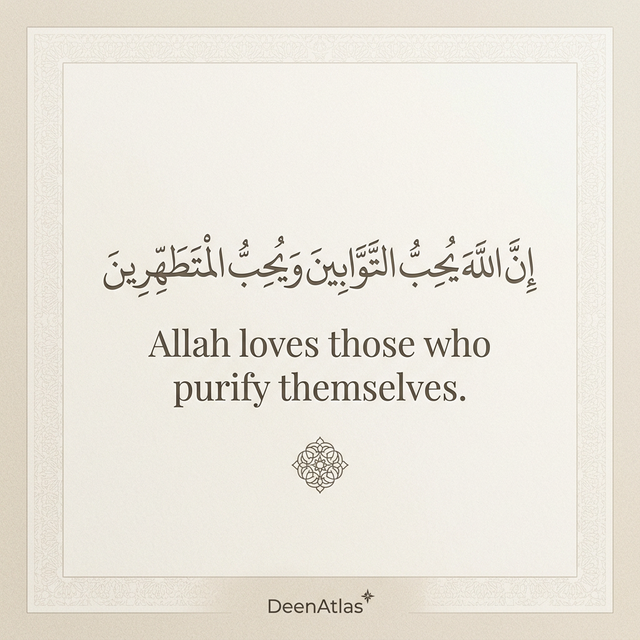
Completion: After the left foot is washed, stand straight. The state of ritual purity is now active. Reciting the Shahadah (Declaration of Faith) followed by the Dua: "Allahummaj-'alni minat-tawwabina waj-'alni minal-mutatahhirin" (O Allah, make me among those who repent and make me among those who purify themselves) is highly rewarded.
5. What Breaks Wudu? (Critical Rules You Must Know)
Understanding what invalidates your purification is just as important as knowing how to perform it. If your Wudu is broken, any prayer performed thereafter will not be accepted until the state of purity is renewed.
As a general rule, anything that exits from the "two paths" (urinary or anal tracts) nullifies Wudu instantly. This is the baseline consensus across all schools of Islamic Law.
The 6 Primary Nullifiers of Wudu
- Passing Wind or Waste: Any discharge from the private parts breaks Wudu immediately.
- Deep Sleep: Sleep where you lose consciousness and muscle control (e.g., lying down) breaks Wudu.
- Loss of Consciousness: Fainting, anesthesia, or seizures invalidate the ritual state.
- Bleeding (Hanafi View): In the Hanafi school, blood that flows from a wound breaks Wudu. In other schools, it doesn't.
- Vomiting (Hanafi View): A mouthful-sized amount of vomit breaks Wudu according to Hanafis.
- Touching Private Parts: Direct skin-to-skin contact with the private parts breaks Wudu according to several schools.
Important Rule: If you are certain you made Wudu but are only doubting whether it broke, you are legally still in a state of purity. "Certainty is not overridden by doubt."
For a deeper, scholarly analysis of hundreds of specific scenarios, visit our comprehensive guide: What Breaks Wudu? The Definitive List & FAQ.
6. Common Wudu Mistakes and How to Correct Them
Even if you know the steps, the quality of your Wudu can be undermined by common habits. Small errors can aggregate into a state of "Technical Impurity" where you think you are clean, but your prayer is not legally accepted.
1. The Rushing Mistake
The Issue: Moving so fast that water is splashed rather than rubbed. Water "beads" on dry skin and doesn't always cover the surface area.
The Correction: slow down. Each limb should be massaged (Dalk) with the hands to ensure total saturation.
Pro-Tip: Count your 1-2-3 washes to force a slower rhythm.
2. The Elbow and Heel Gaps
The Issue: Because these joints have rough/folded skin, water often skips the crevices. The Prophet ﷺ specifically warned about this.
The Correction: Manually rub your elbow with your opposite palm. For the foot, use your hand to scoop water over the back of the heel.
3. Synthetic Barriers (Nail Polish & Makeup)
The Issue: Waterproof substances create a plastic-like shield. If water cannot touch the epidermis, there is no Wudu.
The Correction: All nail polish (even "halal" varieties are debated) and waterproof mascara/foundation must be fully removed.
Tip: Keep a bottle of acetone/makeup remover by your Wudu station.
- Wasting Water: The Prophet ﷺ used less than a liter of water. Avoid leaving the tap blasting.
- Missing the Niyyah: Don't treat it like a spa treatment; treat it like a meeting with the King.
- Incorrect Order: Stick to the sequence precisely as listed in the guide.
- Not Washing the Hand during the Arm Step: Remember the hand is part of the "Arm" unit.
7. The Spiritual Meaning: Purification Beyond the Skin
To reduce Wudu to a hygiene routine is to miss its theological gravity. If it were purely about dirt, a shower would be better. But Wudu is about Niyyah—it is a spiritual reboot.
When you wash your face, you are symbolically preparing to face your Creator. The "blackness" or "dirt" that accumulates on the heart through daily minor sins is being metaphorically scrubbed away. The Prophet ﷺ taught that sins literally drop off with the water as it leaves the skin.
This spiritual cleansing is the prerequisite for Khushu (humility). Imagine standing before a head of state with dirt on your face—the shame would prevent you from speaking clearly. Similarly, Wudu removes the "spiritual shame" of our daily errors, allowing us to speak to Allah with a clear heart.
This hadith transforms Wudu from a chore into a mercy. It is a moment of total optimism. No matter what happened in your day—arguments at work, bad thoughts, or small lies—you have a mechanism to reset. By the time you say "Allahu Akbar" in prayer, you are standing in a state of renewed innocence.
Mindfulness during Wudu is the secret to Khushu in Salah. If you are distracted during Wudu, you will likely be distracted during prayer. Treat the feeling of the water on your skin as a reminder of Allah's presence. Each drop is a miracle of creation.
Reflection Box
As you wash your feet, think about where they took you today. Did you walk toward goodness or towards distraction? Use the physical washing to resolve that for the next few hours, your feet will only walk toward the path of Allah.
8. Nuanced Differences Between the Four Madhabs
While all four schools (Hanafi, Maliki, Shafi'i, Hanbali) agree on the core Quranic steps, they differ on what constitutes a "Pillar" (Fard) versus a "Sunnah."
| Issue | Madhab Position |
|---|---|
| Wiping Head | Hanafi: 1/4th | Shafi'i: A few hairs | Maliki/Hanbali: Entire head |
| Intention | Hanafi: Highly stressed Sunnah | Others: Mandatory Pillar |
| Sequence (Order) | Hanafi/Maliki: Recommended | Shafi'i/Hanbali: Obligatory |
| Wiping Ears | Commonly viewed as Sunnah across all, but techniques vary. |
Why do these differences exist? They stem from the linguistic interpretation of the Quranic verses and the way the Hadith were transmitted. For example, some scholars viewed the "wipe over your heads" command as implying the whole head, while others saw the grammatical structure as implying a part.
Another point of variation is the rule of Muwalah (continuity). The Shafi'i and Hanbali schools mandate that limbs must be washed one after another without a long pause. In the Hanafi school, while a pause is discouraged, the Wudu remains technically valid as long as all parts are eventually washed within a reasonable timeframe.
As a student of Deen, you should follow the method of your local teacher or community. All four paths lead to the same destination: a valid state of purity for the sake of Allah.
9. Frequently Asked Questions (FAQ): Solving Complex Doubts
As the most detailed Wudu guide on the web, we address the complex, edge-case questions that often cause anxiety or doubt for Muslims in their daily worship.
Does bleeding break my Wudu?
The answer depends on your school of thought (Madhab). In the Hanafi school, any blood that flows from a wound site and spills over (meaning it could fall or run) breaks Wudu. If the blood stays exactly as a tiny dot on the cut, it doesn't. However, in the Shafi'i, Maliki, and Hanbali schools, bleeding from a cut or wound does not invalidate your Wudu at all, unless the blood is coming from the private parts. For safety, if you have a significant bleed, it is recommended to clean the area and renew Wudu.
Does deep sleep break my state of purity?
Sleep breaks Wudu if it is "deep sleep" where you lose consciousness and your muscle control relaxes. The benchmark is: Could you have passed wind without realizing it? If you are sitting firmly on the floor and just nod off for a second but remain aware of your surroundings, your Wudu is fine. If you lie down or sleep so deeply that you dream or lose track of time, your Wudu is instantly broken.
Can I pray without Wudu if no water is available?
Yes, Islam provides a beautiful alternative called Tayammum (Dry Ablution). If water is truly unavailable after searching, or if using water would be dangerous for a medical condition (like a severe skin disease), you are permitted to use clean earth or stone to symbolize Wudu. This state replaces Wudu until water becomes available or the medical condition is resolved.
Does touching my spouse or a woman break Wudu?
This is a major point of difference. In the Shafi'i school, any skin-to-skin contact between adult men and women (even spouses) breaks Wudu. The Hanafi school holds that it never breaks it unless there is sexual discharge. The Maliki and Hanbali schools state it only breaks if the touch was done with specific desire (pleasure). Most modern Muslims follow the Hanafi or Maliki view here for ease of life.
Is my Wudu valid with nail polish or acrylics?
Standard nail polish and acrylic nails are waterproof barriers. Because they prevent water from reaching the natural nail, the "washing of the hands" step is physically impossible to complete. Therefore, Wudu with standard polish is invalid. While "breathable" or "halal" polishes exist, many senior councils (like AMJA) recommend removing them to be 100% certain of your prayer's validity, as water penetration is often insufficient.
Can I perform Wudu while in the shower?
Absolutely. If you are already in the shower for hygiene, you can perform Wudu at the end. You must simply make the intention (Niyyah) in your heart and ensure you follow the steps (Face, Arms, Head, Feet) in the correct order. The fact that the rest of your body is also wet does not negate the ritual steps; it actually makes it easier.
Does laughing during my prayer break Wudu?
In the Hanafi school, a distinct rule exists: laughing loudly enough for someone next to you to hear breaks both your Prayer and your Wudu. In other schools, laughing only breaks the Prayer, and you must restart the Salah, but you do not need to repeat the Wudu. Silent smiling never breaks either.
How do I wipe over my socks (Masah)?
This is a Sunnah ease. If you move into a state of Wudu (wash your feet normally) and then put on thick socks that cover the ankles, you don't have to take them off for the next several prayers. You can simply take wet hands and wipe over the top of the socks once. This is valid for 24 hours if you are at home, and 72 hours if you are traveling.
What if I doubt whether I passed wind?
The Prophet ﷺ gave us a clear legal rule: Do not leave your prayer unless you hear a sound or smell an odor. Doubt is the tool of Shaytan. If you clearly remember making Wudu, you are pure until you are certain you broke it. Minor bubbles or movements in the stomach do not count as breaking Wudu.
Does vomiting break my purification?
In the Hanafi school, a mouthful-sized amount of vomit (something you couldn't easily hold back) breaks Wudu. In the Shafi'i school, it does not. Regardless of the school, it is highly recommended to rinse your mouth and renew Wudu for the sake of cleanliness and the spiritual etiquette of prayer.
Do I need Wudu to touch the Quran?
The majority of classical scholars (Hanafi, Maliki, Shafi'i, Hanbali) hold that one must be in a state of Wudu to physically touch the Arabic text of the Quran (The Mushaf). This is based on the verse "None touch it except the purified" (56:79). However, reading from a phone app or reciting from memory does not require Wudu.
How do I handle chronic conditions like incontinence?
Those with "excused" conditions (uncontrollable bleeding or incontinence) are known as Ma'zur. They perform one full Wudu at the beginning of each prayer time (e.g., at the start of Dhuhr). They can then pray as much as they like during that time, even if the condition occurs. Once the time for the next prayer (Asr) begins, they must perform a new Wudu.
Is talking allowed during Wudu?
Talking is permissible (Halal) and does not break the Wudu. However, it is considered Makruh (disliked) to engage in worldly chatter while performing this sacred ritual. It is far better to remain silent or engage in internal Dhikr (remembrance of Allah) to maintain the focus required for the coming prayer.
Does passing out or fainting break Wudu?
Yes. Any loss of consciousness, whether through fainting, medical anesthesia, or seizures, instantly invalidates Wudu. This is because consciousness is the guardian of the physiological state of purity; without it, you cannot be certain if you remained in a state of ablution.
Can I use a spray bottle for Wudu while traveling?
Yes, spray bottles are excellent for conservation. However, there is a technical requirement: the water must flow over the limb. Merely misting the skin so it is damp (like a fog) is not enough for a "wash." There must be enough water that at least one or two drops flow or drip from the limb for the step to be valid.
How do I perform Wudu if I have a bandage or a cast?
If you have a medical bandage or cast that cannot be removed, you perform Masah (wiping) over it. Wash all the healthy parts of the limb normally, and then take wet hands and gently wipe over the surface of the bandage. This is a valid substitute for washing that specific area until the injury heals.
Does using a vape or smoking break Wudu?
Technically, smoking or vaping does not break Wudu as it does not involve any discharge from the "two paths." However, it is highly recommended to rinse your mouth (Madmadah) before prayer to remove the odor and ensure the best etiquette (Adab) while standing before Allah.
Is it allowed to dry the limbs with a towel after Wudu?
Yes, it is perfectly permissible to dry your face, arms, and feet with a clean towel after completing Wudu. While some scholars mention the reward of letting the water drip (as sins fall with the water), there is no prohibition against drying yourself, especially in cold weather or for convenience.
How many times can I pray with a single Wudu?
You can pray as many Fard (obligatory) and Sunnah prayers as you like with a single Wudu, provided you do not do anything that nullifies it. Some Sahaba were known to pray all five daily prayers with one Wudu. However, renewing Wudu for every prayer is a highly rewarded Sunnah (Noor 'ala Noor).
Does Wudu break if I change my clothes or see my own 'awrah?
No, changing your clothes or accidentally seeing your own private parts (or someone else's) does not break Wudu. While modesty is a core Islamic value, the state of ritual purity is only broken by specific physical discharges or loss of consciousness, not by visual exposure.
If you don't see your specific question here, we recommend connecting with our community or reading our further guides on How to Pray in Islam (Salah), Wudu vs Ghusl: What's the Difference?, and Common Mistakes in Salah (Prayer).
10. Conclusion: Standing Pure Before the Divine
Wudu is far more than a physical cleansing; it is the fundamental infrastructure upon which the pillars of our worship are built. By mastering these eight steps, you move beyond mere habit and into a space of intentional devotion. Each drop of water serves as a boundary between the worldly distractions we navigate every day and the sacred stillness required for Salah.
We hope this definitive guide has provided you with the clarity needed to perform your ablution with total confidence. Remember, the goal of Wudu is not perfection in a clinical sense, but sincerity in our effort to be pure. As you move forward in your journey, keep your heart as clean as your limbs, and may Allah accept every drop of water you use as a testament to your faith.
The journey of purification is lifelong. Whether you are performing your Wudu today for your daily prayers or seeking to understand the deeper meanings of Islamic jurisprudence, the value lies in the effort. By dedicating yourself to the proper method of Wudu, you are showing respect for the sacred act of prayer and the profound relationship between the servant and the Creator.