I. Introduction to Spiritual Purification
Purification is one of the central themes of Islamic worship. It is the very first chapter of every book of Fiqh (jurisprudence), serving as the gateway to the sacred act of Salah. Before every prayer, Muslims perform Wudu to cleanse themselves physically, but the purpose of this ritual goes far deeper than merely washing parts of the body.
Islamic scholars explain that purification prepares both the body and the heart for worship. It is a process of transition, shifting the believer from the mundane concerns of the material world into the spiritual presence of the Divine. Without this transition, the prayer risks becoming a hollow set of movements rather than a soulful conversation with Allah.
Wudu symbolises leaving behind worldly distractions and entering a state of spiritual focus. Every drop of water that falls from the limbs carries away more than just dust; it carries away the spiritual fatigue that accumulates during the day. Understanding this meaning helps believers approach prayer with greater awareness and humility.
Key Themes Explorations
- The deeper meaning of purification (Taharah) in Islam
- The spiritual symbolism of each act of Wudu
- How purification prepares believers for the state of Ihsan
- The connection between inner and outer cleanliness
If you want to learn the physical steps of Wudu, we recommend reading our companion guide: How to Make Wudu (Step by Step).
Did You Know? The word "Taharah" translates to both "cleanliness" and "purity." In Islam, these are inseparable. You cannot achieve true spiritual purity while neglecting physical hygiene, nor can you achieve true physical hygiene if your heart is clouded by spiritual filth.
| Aspect | Metaphorical Meaning | Spiritual Impact |
|---|---|---|
| Washing the Face | Awakening the soul to Divine Light | Focusing the attention on Allah |
| Washing the Hands | Letting go of worldly acquisitions | Detachment from material desires |
| Wiping the Head | Submission of the intellect | Humility before Divine Wisdom |
| Washing the Feet | Steadfastness on the straight path | Firmness in faith and action |
Spiritual Goal: Aim to perform your next Wudu not as a habitual routine, but as a conscious act of soul-cleansing. Visualize the spiritual pollutants leaving your body with every wash.
II. Quick Answer: What is the Spiritual Essence?
Purification in Islam (Taharah) represents a holistic state of being where the physical body and the spiritual heart are brought into alignment for worship. It is the mandatory prerequisite for Salah, symbolizing the removal of "spiritual weight" (Hadath) that prevents a soul from standing in the Divine presence.
Wudu symbolises removing sins, distractions and worldly concerns. Every limb involved in Wudu is an instrument of action; by washing them, we are symbolically asking Allah to forgive the sins committed by those limbs and to grant us the strength to use them for good in the future.
Comparison: Physical vs Spiritual
| Aspect | Physical Meaning | Spiritual Meaning |
|---|---|---|
| Action | Washing with clean water | Preparing the heart for worship |
| Symbolism | Removing dirt and sweat | Leaving behind sins and distractions |
| Result | Ritual purity (Taharah) | Spiritual readiness (Khushu) |
This dual nature of purification is what makes Islamic worship unique. It ensures that the believer is fully present—not just in body, but in soul. By following these rules, we honor the Sunnah of the Prophet ﷺ and tap into a source of boundless mercy.
Scholar's Note: Imam Al-Ghazali famously described four levels of purification, ranging from the external limbs to the secret of the heart. To stay on the first level (physical) without progressing to the others is to miss the true beauty of Islamic Taharah.
III. Explore the Spiritual Meaning of Purification
Use our interactive tool below to dive deeper into the specific concepts of spiritual purification. Each selection provides a scholarly explanation and a practical tip for enhancing your spiritual focus.
Purification Explorer
This tool is designed to help you connect the physical acts of Wudu with their metaphysical counterparts. By internalizing these meanings, your daily routine becomes a source of constant spiritual elevation.
IV. The Concept of Purification in Islamic Law
In the Sharia, Taharah (purification) is not merely a recommendation but a foundational legal requirement. It is divided into two main categories: the removal of physical impurity (Najasah) and the removal of ritual impurity (Hadath). While the former is about hygiene, the latter is purely spiritual—a person can be physically clean but still in a state of ritual impurity.
The wisdom behind this distinction is profound. It teaches us that the "unseen" world is just as real as the seen world. Just as we wouldn't want to stand before a king with dirty clothes, we shouldn't want to stand before the King of Kings while the soul is cluttered with the "dust" of daily life and minor transgressions.
Scholarly Definition: Taharah is defined by many jurists as 'the removal of that which prevents the validity of prayer.' This technical definition highlights that purification is the key that unlocks the door to Salah.
The Prophet Muhammad ﷺ said, "Purity is half of faith" (Sahih Muslim). This statement elevates Taharah from a chore to a core pillar of the Muslim identity. It encompasses the cleanliness of the body, the clothes, the environment, and most importantly, the intentions.
When we approach the water for Wudu, we are participating in a tradition that spans centuries. From the scholars of Baghdad to the nomads of the desert, Muslims have always understood that the water they use is a gift from Allah, capable of washing away both physical and spiritual burdens.
The Four Levels of Purity (by Imam Al-Ghazali)
- The first level: Purifying the outer members from impurities and filth.
- The second level: Purifying the members of the body from sins and transgressions.
- The third level: Purifying the heart from blameworthy traits and odious vices.
- The fourth level: Purifying the innermost secret (sirr) from everything other than Allah.
Most people focus only on the first level, but the true seeker of Allah strives to reach the higher levels. Each time you wash your hands, think about the second level—washing away the sins committed by your hands. Each time you rinse your mouth, think about the third level—purifying your speech from backbiting and lies.
| Level | Focus | Goal |
|---|---|---|
| External | Skin and Limbs | Ritual Validity |
| Moral | Actions and Habits | Ethical Character |
| Spiritual | Heart and Intent | Ihsan (Excellence) |
Spiritual Tip: Use the time spent walking to the sink or waiting for the water as a moment of transition. Recite 'Bismillah' with the intention of purifying your soul, not just your skin.
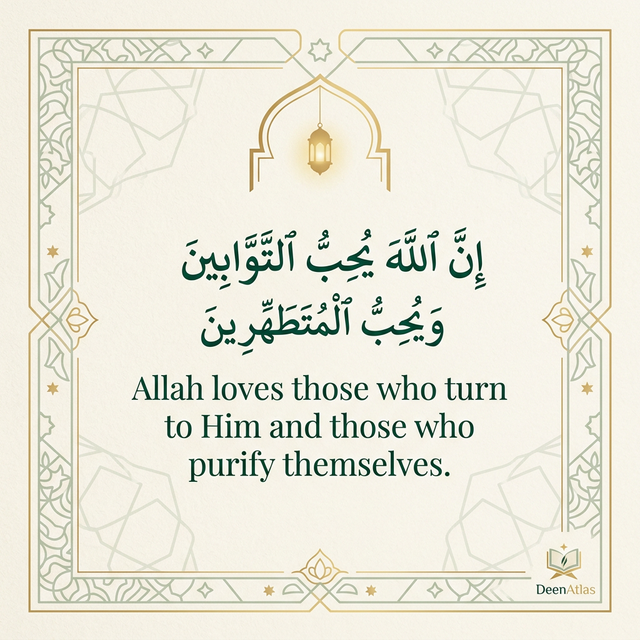
The importance of purification is also emphasized in the Quran. Allah says: "Truly, Allah loves those who turn unto Him in repentance and loves those who purify themselves" (Surah Al-Baqarah 2:222). This love is the ultimate reward for the believer who takes their Taharah seriously.
V. The Spiritual Symbolism of Wudu: A Deep Dive
Wudu is a microcosm of the believer's journey toward Allah. Every step has a literal function and a symbolic meaning. By understanding these symbols, the ritual is transformed into a powerful meditative practice that can significantly impact the quality of your prayer.
Let us explore the symbolic meaning of each major act in Wudu. When we wash our face, we are not just cleaning the skin; we are preparing to see the world with "spiritual eyes." We are asking Allah to brighten our faces on the Day of Judgment, as mentioned in the Hadith: "My people will come on the Day of Resurrection with bright faces and limbs from the traces of Wudu."
Symbolism of the Limbs
- Hands: Representing our interactions with the world. We wash them to signify that we are letting go of worldly greed and grasping.
- Mouth: Representing our speech and nourishment. We rinse it to signify our desire for pure words and Halal sustenance.
- Nose: Representing our discernment. We sniff water to signify our desire to "smell" the fragrance of Paradise and avoid the stench of sin.
- Arms (to the elbows): Representing our efforts and strength. We wash them to ask Allah to accept our deeds and keep us firm in service to Him.
The washing of the head (Masah) is particularly significant. The head is the seat of the intellect and the ego. By wiping it with water, we are symbolically bowing our thoughts and our "self" to the Will of Allah. It is an act of total surrender and humility.
Finally, washing the feet represents our path in life. We walk through the world, often stepping into "spiritual mud." By washing the feet, we rejuvenate our commitment to walk the "Sirat al-Mustaqim" (The Straight Path) and ask Allah for firmness of heart.
Prophetic Wisdom: The Prophet ﷺ said that when a servant washes his face, every sin he committed with his eyes is washed away with the water. This applies to every limb. Imagine this spiritual cleansing as a literal weight being lifted off you.
| Action | Symbolic Meaning | Visualizing Success |
|---|---|---|
| Rinsing Mouth | Cleansing speech | "May my words be truthful and kind." |
| Washing Arms | Cleansing actions | "May my deeds be heavy on the scales." |
| Wiping Head | Surrendering ego | "I submit my pride to You, Ya Allah." |
| Washing Feet | Fixing the path | "Guide my steps to your pleasure." |
Reflection Exercise: Next time you perform Wudu, focus specifically on one limb and its symbolic meaning. For one week, focus on the mouth—concentrate on the purity of your speech after setiap Wudu.
The use of water itself is a symbol of life and renewal. Just as water brings dead land back to life, Wudu brings a tired spirit back to life. It is the "living water" of the soul, a constant source of refreshment in a desert of worldly stress.
Section Summary Table
| Movement | Metaphysical Goal |
|---|---|
| Bismillah | Setting the sacred intention |
| Water flow | The mercy of Allah descending |
| Completion | A soul ready for connection |
VI. Purification of the Heart: The Inner Taharah
While Wudu addresses the body, the true objective of Islam is the purification of the heart (Tazkiyah al-Nafs). The heart is the "king" of the body, and if it is pure, the rest of the body follows. A person can perform the most perfect physical Wudu, but if their heart is full of pride or hatred, their spiritual state remains compromised.
Islamic spirituality teaches that the heart can become "rusted" by sins and worldly attachment. Just as iron rusts when exposed to moisture without care, the heart rusts when exposed to the distractions of the world without the "polish" of Dhikr and sincere worship. Purification of the heart is the process of removing this rust.
The Golden Rule: True Taharah is when the inside matches the outside. If you appear clean to people but feel dirty before Allah, you have yet to achieve the essence of purification.
What are the pollutants of the heart? Scholars identify several "diseases," including:
- Riya (Showing off): Performing good deeds to be seen by others rather than for Allah.
- Hasad (Envy): Wishing for the blessings of others to be removed.
- Kibr (Pride): Feeling superior to others based on wealth, lineage, or even piety.
- Hubb al-Dunya (Love of the world): Excessive attachment to material wealth and fame.
The Remedies for the Heart
| Disease | Spiritual Remedy | Practical Action |
|---|---|---|
| Envy | Contentment (Rida) | Make Dua for the person you envy |
| Pride | Humility (Tawadu) | Serve someone 'lower' than you |
| Greed | Generosity (Jūd) | Give secret charity regularly |
Wudu acts as a physical anchor for this inner work. Each time we wash ourselves, we should remind ourselves to wash away these diseases. When we rinse our mouth, we ask Allah to purify us from backbiting. When we wash our face, we ask for the light of Sincerity (Ikhlas).
Deep Reflection: Imam Al-Ghazali said, 'The one who restricts himself to the outer purification is like a person who wants to invite a King to his house, so he paints the outer gate but leaves the inside of the house full of trash.'
The connection between physical Wudu and heart purification is mentioned in the Du'a after Wudu: "O Allah, make me among those who repent and make me among those who purify themselves." Repentance (Tawbah) is the Wudu of the heart. Just as water cleans the skin, Tawbah cleans the soul.
Takeaway: The Heart First
Never let the physical act of Wudu be a distraction from the spiritual state of your heart. Use the ritual as a reminder to check in with your soul. Are you angry? Are you proud? Let the water be a symbol of cooling those negative fires.
VII. The Connection Between Purification and Prayer
Why is purification mandatory for prayer? Could we not just pray while we are physically clean but ritually "unclean"? The answer lies in the nature of Salah as a "Mi'raj" (ascent) for the believer. To ascend to the Divine presence, one must shed the weight of the mundane world. Purification is that shedding process.
When you stand in prayer, you are having a private conversation with the Creator of the universe. This requires a level of respect and preparation that exceeds any worldly meeting. Wudu creates a "sacred space" around the worshiper. It signals to the mind and body that the "ordinary time" has ended and "sacred time" has begun.
The Buffer zones of Wudu
- The Physical Buffer: Cleaning the limbs used for worldly work.
- The Mental Buffer: Using the silence of Wudu to quiet the brain.
- The Spiritual Buffer: Entering the state of 'Taharah' to protect the prayer from Satanic whispers.
Without Wudu, the transition into prayer is often abrupt and distracted. We bring the stress of the office or the noise of the street directly into our Salah. Wudu acts as a cooling mechanism—literally and figuratively. The water cools the nerves and the heart, making it easier to achieve "Khushu" (devotion).
This is why scholars recommend performing Wudu thoroughly and according to the Sunnah. Rushing through Wudu often leads to a rushed prayer. If the preparation is done with care and mindfulness, the prayer will naturally follow that same pattern of excellence.
Scholar's Insight: Many pious predecessors used to tremble when they performed Wudu. When asked why, they would say: 'Do you not know Whom I am about to stand before?' For them, Wudu was already the beginning of the meeting with Allah.
| Stage of Prayer | Role of Purification | Spiritual Benefit |
|---|---|---|
| Before Takbir | Wudu and Clean clothes | Establishing dignity and respect |
| During Recitation | Ritual Purity | Protecting the heart from distractions |
| During Prostration | Physical Cleanliness | Total humility and closeness |
The Prophet ﷺ said: "The key to prayer is purification..." (Sunan Abi Dawud). Just as you cannot enter a locked room without a key, you cannot enter the "heavenly room" of the prayer without the key of Taharah.
VIII. Scholarly Reflections on Purity and Light
Throughout history, Islamic sages and scholars have reflected deeply on the "light" (Nur) of Wudu. They observed that the believer who maintains their Wudu has a certain radiance—not just physically, but in their character and presence. This is the effect of constant spiritual renewal.
Ibn al-Qayyim mentioned that purification has a purifying effect on the mind. It clears away the "fog" of worldly desire and helps the believer see the truth (Haqq) more clearly. He argued that the soul that is constantly in a state of Wudu is less susceptible to the whispers of despair and anger.
A Pious Practice: Many scholars of the past would renew their Wudu even if they hadn't broken it, simply to increase their spiritual light. This is known as 'Nur 'ala Nur' (Light upon Light).
Let's look at some specific scholarly quotes regarding Taharah:
Pearls of Scholarly Wisdom
- Hasan al-Basri: "I am amazed at the one who seeks help from Allah while his limbs are dirty with sins. Clean your limbs with Wudu and your soul with repentance."
- Imam Malik: "Knowledge is a light that Allah places in the heart. It does not stay in a heart that is habitually impure."
- Sheikh Abdul Qadir Jilani: "The Wudu of the body is with water, but the Wudu of the heart is with the water of tears shed in repentance."
These reflections remind us that Wudu is a living Sunnah. It is a gift passed down from the Prophet ﷺ to enable us to reach higher states of consciousness. It is a protection (Hisn) for the believer in a world that is often spiritually taxing.
The Light of Wudu: Some scholars believe that the 'bright spots' on the limbs of believers on the Day of Judgment will be proportional to the thoroughness and mindfulness of their Wudu in this life.
IX. Differences Between Madhabs on Inward Acts
While all four Sunni Madhabs agree on the physical pillars of Wudu, they have subtle differences in how they view the "recommended" (Sunnah) and "spiritual" aspects of the ritual. These differences are a source of richness and flexibility in our Deen.
For example, the Shafi'i school emphasizes the 'Niyyah' (intention) at the very moment the water touches the first part of the face. This ensures that the act is distinct from a mere habitual wash. The Maliki school emphasizes 'Dalk' (rubbing), which signifies the thoroughness and care with which one should treat the ritual.
| Madhab | Key Emphasis | Spiritual Lesson |
|---|---|---|
| Hanafi | Order and Continuity | Discipline and persistence in life. |
| Maliki | Rubbing (Dalk) | Dedication and effort in worship. |
| Shafi'i | Intention (Niyyah) | Consciousness of the heart's state. |
| Hanbali | Basmalah as mandatory | Beginning everything in God's name. |
Understanding these differences helps us appreciate the focus of each school. Whether you follow the literal rigor of the Hanbalis or the philosophical depth of the Hanafis, the goal remains the same: to stand before Allah in the best possible state of body and soul.
X. Frequently Asked Questions
Does Wudu wash away sins literally?
Yes, based on multiple authentic Hadith, Wudu washes away minor sins committed by the limbs being washed. As the water falls, the sins 'fall away' from the believer. However, major sins (Kaba'ir) require sincere, direct repentance (Tawbah) and, in some cases, restitution to others if the sin involved their rights.
Can I perform Wudu without water for spiritual purposes?
For ritual validity, if water is unavailable or its use is harmful, a believer performs Tayammum (dry ablution) using clean earth. This preserves the spiritual continuity of preparation. Spiritually, the 'Wudu of the heart'—which involves constant Dhikr (remembrance) and Muraqabah (mindfulness)—can and should be performed regardless of your physical ritual state.
Why is it Sunnah to use very little water?
The Prophet ﷺ warned against wasting water, even if performing Wudu at a flowing river. This Sunnah teaches us discipline, environmental stewardship, and the realization that the 'purity' comes from the blessing (Barakah) of the act, not the volume of the liquid used. It forces the believer to be more deliberate and careful in their movements, preventing heedlessness.
Is it necessary to have a spiritual intention for Wudu?
From a legal (Fiqh) standpoint, a basic intention to remove the state of ritual impurity for prayer is sufficient for the Wudu to be valid. However, for spiritual reward and depth, having a conscious intention to purify the soul, seek Allah's love, and follow the Sunnah of the Prophet ﷺ is highly recommended and adds immense value to the act.
What should I do if I am distracted during Wudu?
Distraction doesn't invalidate the Wudu's legal status, but it can diminish its spiritual buffer effect. If you catch yourself thinking about work or stress, simply recite 'Astaghfirullah' (I seek Allah's forgiveness) and bring your heart back to the sensation of the water. Remind yourself that you are about to stand before the Creator of the Heavens and the Earth.
How does purification affect mental health?
Many Muslims find the ritual of Wudu to be a powerful form of 'grounding'. It reduces the physiological symptoms of stress (like heat and tension) and provides a structured moment of peace in a hectic day. The cooling effect of water and the focus on the present moment act as a natural mindfulness exercise that aligns the psyche with the spirit.
What is the 'Wudu of the Nafs' (the Self)?
The 'Wudu of the Nafs' refers to the ongoing struggle (Jihad al-Nafs) to clean one's character from negative traits like anger, greed, and envy. Just as the body needs water five times a day, the Nafs needs the constant 'washing' of self-reflection and Divine remembrance to stay healthy and vibrant.
Does the state of Wudu protect against 'Waswasah'?
Yes, scholars have long noted that Shaytan struggles to influence a soul that is in a constant state of ritual and spiritual purity. Wudu acts as a light that makes the spiritual environment uncomfortable for negative whispers, allowing the believer to maintain better focus and emotional stability throughout the day.
Can children understand the spiritual meaning?
Absolutely. Children are often more receptive to the symbolic nature of Wudu. Teaching them that they are 'washing away sadness' or 'making their hearts shine' can help them develop a loving relationship with the Deen from a young age, turning the routine of washing into a joyful spiritual experience.
How do I maintain my state after Wudu is over?
The best way to maintain the 'Nur' of Wudu is to keep your tongue moist with the remembrance of Allah and to avoid engaging in idle or negative talk immediately after. Try to move directly from the place of Wudu to the place of prayer with as little interruption as possible, keeping the 'state of transition' active.
Purification remains a topic of immense depth and beauty. Many believers wonder if their Wudu is "good enough" if they don't feel a profound spiritual shift every single time they approach the water. It is important to remember that Wudu is an act of worship in its own right—an act of obedience to the command of Allah.
Even if you don't feel an immediate change in your emotions, the act of obedience and the physical cooling of the water have subtle effects on the soul that are not always visible. The spiritual benefits are cumulative; the more you treat Wudu with respect, the more the prayer that follows it will begin to heal and transform your life.
The more you practice mindfulness (Muraqabah) during the ritual, the more you will begin to feel its spiritual effects over time. It is like a muscle that needs consistent training and persistent effort. Start by simply reciting the Du'as of Wudu with deep focus and slowly move toward visualizing the spiritual cleansing of the limbs and the heart as we have discussed in this guide.
Furthermore, consider the communal aspect of these questions. Sharing this knowledge with family and friends can be a form of Sadaqah Jariyah. When a whole household performs Wudu with such depth and awareness, the home itself becomes a sanctuary of peace, light, and divine protection.
XI. Conclusion: Moving Towards Inner Purity
We have explored the journey of purification from the physical limbs to the secret depths of the heart. Wudu is not a hurdle to clear before prayer; it is the first act of the prayer itself. It is the moment where we decide to leave the world behind and seek the presence of the Almighty.
By internalizing the spiritual symbolism of purification, we transform a five-minute routine into a lifelong practice of soul-polishing. We learn to value the "unseen" purity as much as the seen, and we honor the beautiful balance that Islam provides between our physical needs and our spiritual aspirations.
Premium Learning Recap
- Holistic Purity: Combine physical Wudu with sincere heart renewal.
- Mindful Action: Use the symbolism of the limbs to focus your intention.
- Constant Growth: Strive for the higher levels of purification taught by the sages.
May Allah accept our purification, wash away our sins, and brighten our faces on the Day we meet Him. May our hearts be as pure as the water we use, and may our lives reflect the cleanliness and dignity of the Sunnah.