During every single formal Islamic prayer (Salah), Muslims explicitly and audibly recite sacred, unaltered verses directly from the Holy Quran. It is an incredibly beautiful, intensely deeply spiritual practice.
Every single unit of prayer, universally known as a rakat, strictly requires the absolute, flawless recitation of Surah Al-Fatiha, which is appropriately known as "The Opening" chapter of the divine book.
This opening chapter is then traditionally immediately followed by the formal recitation of yet another passage from the Quran, creating a highly customized, deeply personal interaction with God.
Understandably, millions of Muslims globally desperately wonder exactly which specific surahs are most commonly recited during their daily prayers, seeking to rigorously emulate the authentic practice of Prophet Muhammad ﷺ.
The Divine Guarantee: The Quran was explicitly revealed as an accessible, universal message for absolutely all of mankind. The Prophet ﷺ heavily emphasized that believers should absolutely never feel utterly overwhelmed by the length of recitation in standard daily prayers.
The divine text contains 114 completely unique chapters of radically varying lengths. Some chapters are extraordinarily short and overwhelmingly easy for absolute beginners to memorize perfectly.
Conversely, others are massively long, intensely detailed, and are traditionally often recited beautifully during the deep silence of the late night, voluntary prayers by highly dedicated worshipers.
Profoundly understanding exactly which specific surahs can be properly recited helps everyday believers proactively develop massive confidence in the fundamental validity and spiritual depth of their daily prayer.
In this extraordinarily detailed guide, we will systematically explain deeply:
- Exactly what specific surahs are authentically recited in Salah
- Precisely why Surah Al-Fatiha is an absolute fundamental requirement
- The absolute best short surahs commonly recommended for beginners
- The profound meaning and intense reflection behind daily recitation
- Complex scholarly explanations regarding Quran recitation during prayer
Prerequisite Reading:
If you are currently still learning the absolute,
fundamental basics of how to physically perform the
prayer itself, please read our foundational guide
first before continuing to learn these advanced recitation
guidelines:
- How to Pray in Islam (Salah)
Choose a Surah for Prayer
Selecting precisely which surah to recite can occasionally feel completely overwhelming, especially when you are desperately trying to balance limited memorization with the strong desire to vastly improve your worship.
Use the incredibly simple interactive tool directly below to instantly explore highly recommended, authentically documented surahs commonly recited in Salah by Muslims worldwide.
Click through the specific tabs to see excellent recommendations specifically curated for absolute beginners requiring short phrases, right through to advanced practitioners engaging in massive night prayers.
Best Surahs for Beginners
Recommended Surah: Surah Al-Ikhlas (Chapter 112)
Meaning: "Say, 'He is Allah, [who is] One, Allah, the Eternal Refuge...'" It defines the absolute core doctrine of Islamic monotheism (Tawheed).
When Commonly Recited: Recited globally in almost every daily prayer, especially by beginners, because it is extremely short (only 4 verses).
Standard Short Recitation
Recommended Surahs: Surah Al-Falaq (Ch. 113) & Surah An-Nas (Ch. 114)
Meaning: The "Mu'awwidhatayn" (The Two Chapters of Refuge). They seek immense divine protection from evil, magic, arrogance, and the whispering of Satan.
When Commonly Recited: Extremely common in the Sunnah and Fard prayers of Maghrib and Isha where short recitations are preferred.
Longer Recitation (For Fajr)
Recommended Surahs: Surah Ya-Sin (Ch. 36) or Surah Ar-Rahman (Ch. 55) (or specific long passages)
Meaning: These longer chapters explore the profound depth of resurrection, divine mercy, and the incredible mathematical majesty of creation.
When Commonly Recited: The Sunnah highly emphasizes reciting much longer chapters explicitly during the Fajr prayer when the mind is fresh and angels are present.
Night Prayer (Tahajjud)
Recommended Surahs: Surah Al-Mulk (Ch. 67) or Al-Baqarah passages
Meaning: Themes surrounding the absolute sovereignty of the Creator over life and death, providing massive perspective shifts.
When Commonly Recited: In the deep silence of the night prayer (Qiyam/Tahajjud) where the believer can recite slowly and reflect deeply without interruption.
3. Why Surahs Are Recited in Prayer
To deeply understand exactly why specific surahs are recited, we must fundamentally grasp the absolute core purpose of Islamic prayer. Salah is not merely a physical exercise or a set of empty, repetitive rituals.
It is an incredibly profound, direct, and desperately intimate daily conversation between the created human being and the Creator of the universe. When a Muslim recites the Quran, they are actively engaging in divine dialogue.
The Requirement of Surah Al-Fatiha
The absolute cornerstone of every single physical unit of prayer (rakat) is the flawless recitation of Surah Al-Fatiha. The Prophet ﷺ categorically and explicitly stated: "There is absolutely no prayer for the one who does not formally recite the Opening of the Book."
This specific chapter is considered universally by classical scholars to be the absolute summary of the entire Quran. It contains intense praise, absolute submission, and a desperate plea for divine guidance on the straight path.
Without the flawless recitation of Al-Fatiha, whether you are the Imam leading thousands or praying completely alone in your bedroom, that specific unit of prayer is legally and spiritually completely invalid.
The Addition of Other Chapters
After respectfully completing Al-Fatiha, it is a highly emphasized Sunnah (prophetic tradition) to immediately recite an additional passage from anywhere else in the Quran during the absolutely critical first two rakats of any obligatory (Fard) prayer.
For the remaining third and fourth rakats (in Dhuhr, Asr, Maghrib, and Isha), the Sunnah strongly dictates that a worshipper simply recites Surah Al-Fatiha entirely alone, remaining completely silent afterward until bowing.
Spiritual Diversity: While Al-Fatiha provides the necessary, unshakable structural foundation of the prayer, the additional surahs provide incredible daily variety. This prevents the daily prayer from becoming a mindless, heavily robotic routine by constantly introducing new divine themes and stories.
4. Surahs Commonly Recited in Salah
While a Muslim can technically and legally recite absolutely any portion of the Quran from memory, there are specific chapters that the Prophet Muhammad ﷺ was historically documented to have favored during specific daily prayers.
Understanding these historical prophetic patterns allows modern believers to massively elevate their own daily worship by deliberately aligning it globally with the exact practice of the Messenger of Allah.
Fajr Prayer (The Dawn)
The Fajr prayer famously consists of only two obligatory rakats, yet it is traditionally widely known for featuring the longest and most beautiful recitation of all five daily prayers. The mind is extraordinarily fresh and the world is silent.
The Prophet ﷺ frequently recited chapters from the "Tiwal al-Mufassal" (the longer chapters of the final section of the Quran), such as Surah Qaf (Ch. 50) naturally through to Surah Al-Mursalat (Ch. 77). The Quran explicitly notes that the recitation at dawn is physically witnessed by angels.
Dhuhr and Asr (The Daytime)
These specific daytime prayers are unique precisely because they are performed completely silently. The Imam does not recite audibly, and individuals praying completely alone move their lips silently.
In these intensely quiet prayers, it is heavily recommended to recite medium-length chapters, such as Surah At-Tariq (Ch. 86) or Surah Al-Ala (Ch. 87), providing a profound, silent spiritual break directly in the middle of a chaotic, busy workday.
Maghrib (The Sunset)
Since Maghrib is performed right at the critical moment of sunset when the available time is extremely short, the highly established Sunnah is to keep the recitation incredibly brief so as not to dangerously delay the prayer.
Chapters from the "Qisar al-Mufassal" (the very shortest chapters at the absolute end of the Quran) are naturally heavily utilized here. Surah Al-Ikhlas, Al-Falaq, An-Nas, and Al-Kawthar are absolute staples of the global Maghrib prayer.
Isha (The Night)
The Isha prayer comfortably allows for moderate, beautifully unhurried recitation. The day is finally officially over, and people are relaxing. The Prophet ﷺ famously read chapters like Surah At-Tin (Ch. 95) and Surah Ash-Shams (Ch. 91).
5. Short Surahs for Absolute Beginners
For new Muslims instantly trying to learn the complicated physical movements of the prayer, or for those who simply struggle heavily with Arabic memorization, the prospect of reciting chapters of the Quran can feel completely paralyzing.
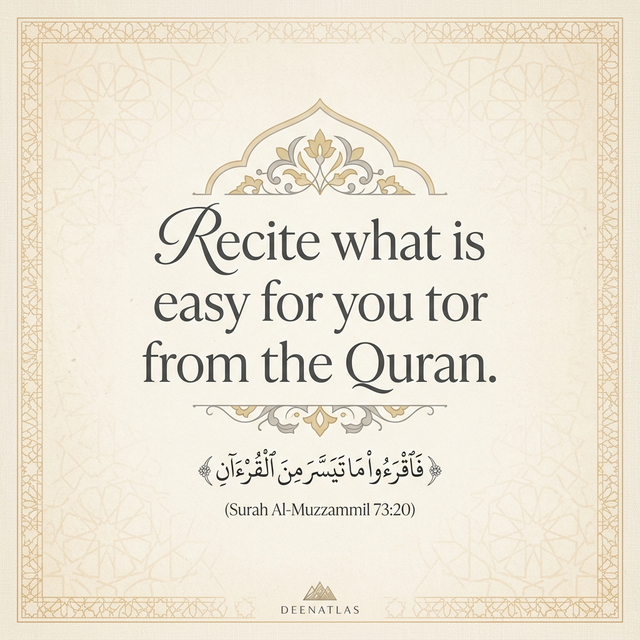
Islam is fundamentally a religion of profound ease. The Quran itself explicitly commands believers: "Recite what is easy for you of the Quran." There is absolutely no sin in continuously repeating the shortest available chapters.
Surah Al-Ikhlas (Chapter 112) is particularly heavily emphasized. Despite consisting of merely four incredibly short verses, the Prophet ﷺ explicitly declared that reciting it possesses the exact same monumental spiritual weight as reading one entire third of the Holy Quran.
A famous authentic historical account mentions a devoted companion who literally recited Surah Al-Ikhlas in absolutely every single rakat he prayed because he loved its profound description of Allah. The Prophet ﷺ responded by confirming that Allah loved him exactly in return.
6. Meaning and Reflection in Recitation (Khushu)
Merely pronouncing the Arabic syllables rapidly and perfectly is absolutely not the ultimate, final goal of Quranic recitation in Salah. The deeply fundamental objective is profound reflection (Tadabbur) and overwhelming reverence (Khushu).
When a believer deliberately chooses a specific surah to recite, they should ideally understand its core translation and actively engage with its heavy emotional themes throughout the physical duration of the prayer.
Engaging with the Verses
The Prophet Muhammad ﷺ historically demonstrated an incredibly intensely emotional relationship with the verses he actively recited during his night prayers. His recitation was never flat, robotic, or rushed.
When he recited a specific verse explicitly warning of divine punishment and Hellfire, he would visibly pause his recitation and audibly seek immediate protection from it. When he recited a beautiful verse describing infinite divine mercy, he would pause and explicitly ask for it.
Interactive Worship: This highly authentic prophetic tradition proves that recitation inside Salah is meant to be deeply interactive at a psychological level. The worshipper is not a tape recorder; they are a desperate servant actively pleading with their Master.
7. Common Mistakes in Recitation
Because Arabic relies heavily on incredibly precise pronunciation rules (Tajweed), beginners often make unintentional technical errors during their daily recitation. Understanding these common pitfalls actively helps believers violently protect the fundamental validity of their daily worship.
- Rushing the Recitation: The absolute most destructive mistake is reading at breakneck speed simply to physically finish the prayer faster. The Quran severely commands: "And recite the Quran with measured recitation."
- Changing Core Meanings: Mispronouncing heavy Arabic letters (like swapping a soft 'H' for a hard 'H') can literally completely change the literal meaning of a sacred word. While unintentional mistakes are universally forgiven, deliberately neglecting to learn proper pronunciation is considered sinful by major scholars.
- Reciting the Exact Same Surah: While entirely legally permissible, constantly reciting only Surah Al-Ikhlas for decades heavily deprives the worshipper of the vast, incredible oceans of wisdom found in the remaining 113 chapters of the Quran.
8. Differences Between Madhabs (Schools of Thought)
While the absolute necessity of Surah Al-Fatiha is universally agreed upon globally, the four major Sunni schools of jurisprudence possess fascinating, highly specific minor differences regarding exactly how the additional surahs are technically handled.
The Obligation of the Additional Surah
Hanafi School: The Hanafi scholars strictly mandate (Wajib) that an additional short surah (or equivalent three verses) absolutely must be recited after Al-Fatiha in the first two rakats. Intentionally omitting it strictly requires a prostration of forgetfulness.
Shafi'i, Maliki, and Hanbali Schools: The vast majority explicitly categorize the additional recitation strongly as a highly recommended Sunnah, not a strict obligation. While highly discouraged to simply skip it, omitting it does not fundamentally technically damage the core validity of the prayer itself.
Reciting Behind an Imam
When actively praying in a physical congregation behind an audible Imam (like in Maghrib or Fajr), the scholars heavily differ regarding what the follower should do.
The Hanafi and Maliki absolute rule is that the follower must remain completely, pin-drop silent and simply listen intensely to the Imam's beautiful recitation. The Shafi'i position strongly dictates that the follower must personally quickly murmur Surah Al-Fatiha silently to themselves during the Imam's brief pauses.
9. Frequently Asked Questions (FAQ)
Selecting and accurately reciting Quranic verses daily inevitably generates dozens of highly practical logistical questions for normal believers. Here are the absolute most commonly asked global queries perfectly clarified based on major scholarly consensus.
Do I have to recite a new surah in every single rakat?
You absolutely must accurately recite Surah Al-Fatiha in every single rakat you pray, without exception. However, reciting an additional entirely different surah after Al-Fatiha is only strongly recommended (sunnah) specifically in the first two rakats of any standard obligatory prayer.
Can I read directly from the Quran app on my phone during Fard prayer?
For obligatory (Fard) daily prayers like Dhuhr or Asr, the vast majority of classical scholars absolutely prohibit holding physical objects and reading externally, as it constitutes excessive physical movement. You must recite strictly from your own memory. However, for voluntary night prayers (Tahajjud), reading directly from a physical Mushaf or phone is widely permitted by many major scholars to encourage longer recitations.
What happens if I forget to recite a surah after Al-Fatiha?
Do not panic. If you successfully recited Surah Al-Fatiha, the absolute core foundation of your prayer is perfectly valid intact. Forgetting the additional secondary surah does not fundamentally break your Salah. Within the Hanafi school, it is highly recommended to perform a prescribed prostration of forgetfulness (Sujood as-Sahw) explicitly to repair this minor deficiency at the end.
Is it permissible to recite the exact same surah in both rakats?
Yes, it is completely legally permissible to repeatedly recite exactly the same chapter (for example, Surah Al-Ikhlas) in both the first and second rakat. While it is obviously historically the Sunnah to diversify and read two distinctly different chapters to gain wider exposure to the Quran, your prayer is entirely accepted if you repeat the same one.
Do I say Bismillah before the second surah?
If you are formally starting a completely new surah directly from its very first verse (like Surah Al-Kawthar), then softly saying "Bismillah ir-Rahman ir-Rahim" is considered a beautiful Sunnah. However, if you are jumping straight into the middle of a random long chapter (like reciting verse 255 of Al-Baqarah), you do not traditionally say Bismillah.
10. Conclusion
Reciting the pristine, unaltered words of the Quran during the daily prayer remains one of the most intellectually beautiful and spiritually profound pillars of regular Islamic worship.
Through the intensely disciplined daily repetition of Surah Al-Fatiha and the glorious inclusion of various other chapters, modern Muslims globally continuously reflect deeply on the exact words of Allah, actively strengthening their invisible connection with the Creator of the universe.